Dettagli
Anno di pubblicazione
1883
Descrizione
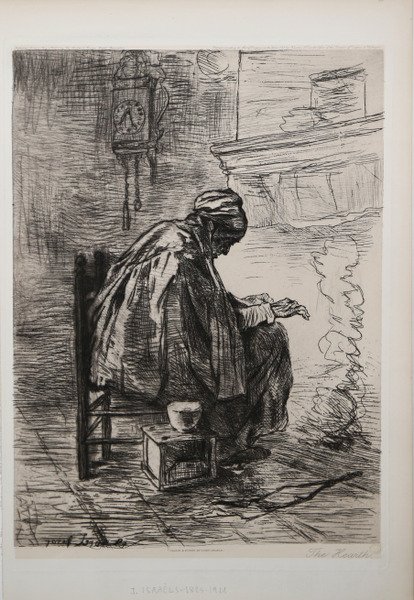
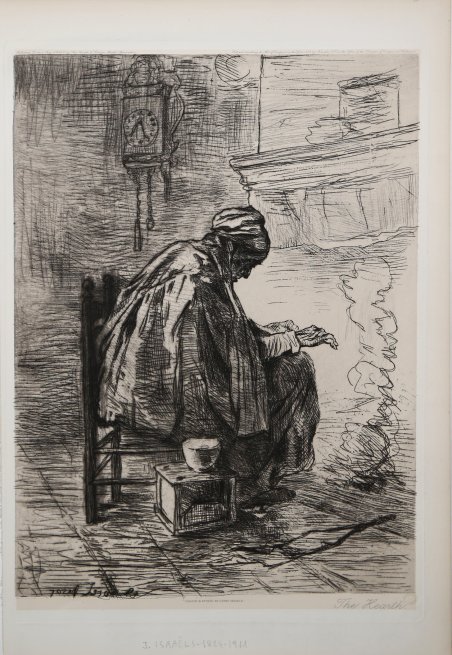
Acquaforte, 1883; in alto a sinistra: Published London, July 18th.,1883 by The English & Foreign Artists' Association. in basso a sinistra (graffiato nella lastra): Jozef Israels. Lettera in margine inferiore: Drawn and etched by Josef Israels / The hearth. Stato unico Hubert scrive che "The Hearth" fu pubblicato in una sola edizione dalla Knoedler & Company di New York e dalla British and Foreign Artists' Association il 18 luglio 1883 a Londra. Non furono fatte altre edizioni. Tutte le impressioni di questa importante acquaforte portano il timbro a secco della Printseller's Association nell'angolo inferiore destro, accanto al titolo. Jozef Israëls, (1824, Groninga, 1911, L'Aia), pittore e incisore, spesso chiamato Dutch Millet (un riferimento a Jean-Fran?ois Millet) fu il leader della scuola dell'Aia di pittura di genere contadina, che fiorì nei Paesi Bassi tra il 1860 e il 1900. Iniziò i suoi studi ad Amsterdam e dal 1845 al 1847 lavorò a Parigi sotto i pittori accademici Horace Vernet e Paul Delaroche. Israëls cercò per la prima volta di affermarsi come pittore Romantico di ritratti e quadri storici convenzionali, ma aveva ottenuto scarso successo quando nel 1855 la cattiva salute lo costrinse a lasciare Amsterdam per il villaggio di pescatori di Zandvoort, vicino ad Haarlem. Quel cambiamento di scenario rivoluzionò la sua arte: si rivolse a rappresentazioni realistiche e compassionevoli dei contadini e dei pescatori olandesi. Nel 1871 si trasferì a L'Aia e lavorò spesso nella vicina Scheveningen. Oltre agli oli, Israëls ha lavorato con gli acquerelli ed è stato un incisore di prim'ordine. I suoi dipinti sobri e trattenuti che descrivono la vita nel villaggio di pescatori gli hanno fatto guadagnare fama internazionale. I critici paragonarono la sua pennellata a impasto, i suoi colori caldi e il suo uso del chiaroscuro al lavoro di Rembrandt. Israëls insegnò a numerosi allievi, tra cui suo figlio Isaac. Bibliografia H. J. Hubert, The Etched Work of Jozef Israels: An Illustrated Catalogue, 29. Etching, 1883; inscribed upper left: Published London, July 18th.,1883 by The English & Foreign Artists’ Association. lower left (scratched in plate): Jozef Israels. Lettered in lower margin: Drawn and etched by Josef Israels / The hearth. Only state. Hubert writes that "The Hearth" was published in one edition only by Knoedler & Company in New York and the British and Foreign Artists' Association on July 18, 1883 in London. No further editions were made. All impressions of this important etching bear the official blindstamp of the Printseller's Association in the lower right corner, beside the title. Jozef Israëls, (1824, Groningen, Netherlands—1911, The Hague) painter and etcher, often called the “Dutch Millet” (a reference to Jean-Fran?ois Millet). Israëls was the leader of the Hague school of peasant genre painting, which flourished in the Netherlands between 1860 and 1900. He began his studies in Amsterdam and from 1845 to 1847 worked in Paris under the academic painters Horace Vernet and Paul Delaroche. Israëls first tried to establish himself as a painter of Romantic portraits and conventional historical pictures but had achieved little success when in 1855 ill health compelled him to leave Amsterdam for the fishing village of Zandvoort, near Haarlem. That change of scenery revolutionized his art: he turned to realistic and compassionate portrayals of the Dutch peasantry and fisherfolk (e.g., Waiting for the Herring Boats, 1875). In 1871 he moved to The Hague, and he often worked in nearby Scheveningen. Besides oils, Israëls worked in watercolours and was an etcher of the first rank. His later works in all media express a tragic sense of life and are generally treated in broad masses of light and shade. His painting style was influenced by Rembrandt’s later works, and, like Rembrandt, Israëls often painted the poor Jews of the Dutch ghettos (e.g., A Son of the Chosen People, 1889). His son Isaac (1865–1934), also a painter, adopted an Impressionist technique and subject matter and had some influence on his father’s later work. Bibliografia H. J. Hubert, The Etched Work of Jozef Israels: An Illustrated Catalogue, 29. Cfr.

 Scopri come utilizzare
 Scopri come utilizzare