RITRATTO NEL QVALE SI RAPPRESENTA IL VERO SITO DELL’HORTI.
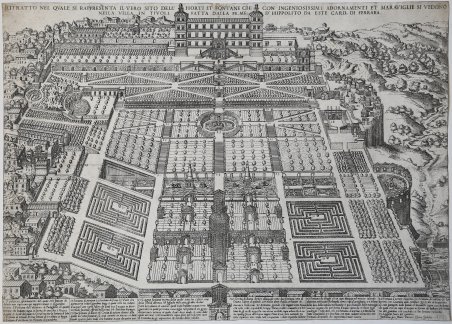
RITRATTO NEL QVALE SI RAPPRESENTA IL VERO SITO DELL’HORTI.
Metodi di Pagamento
- PayPal
- Carta di Credito
- Bonifico Bancario
- Pubblica amministrazione
- Carta del Docente
Dettagli
- Anno di pubblicazione
- 1575
- Formato
- 515 X 370
- Incisori
- CARTARO Mario
Descrizione
Acquaforte e bulino, firmata in basso a destra: «In Roma per Mario Kartaro l'anno Jubileo 1575». Parte dello Speculum Romanae Magnificentiae. Iscritto in alto: «RITRATTO NEL QVALE SI RAPPRESENTA IL VERO SITO DELL’HORTI, ET FONTANE CHE CON INGENIOSISSIMI ADORNAMENTI ET MARAVIGLIE SI VEDONO NELLA VILLA IN TIVOLI, FATTA DALLA FE[LICE] ME[MORIA]D’HIPPOLITO DA ESTE CARD[INALE] DI FERRARA» Dopo aver lavorato al Casino di Pio IV (1559-1565) in Vaticano, Pirro Ligorio lavorò a Villa d’Este a Tivoli. Il contributo del Ligorio non risulta dai documenti, ma la sua carica di antiquario di Casa d’Este e le affinità della villa tiburtina con il Casino di Pio IV inducono ad attribuire al Ligorio la sistemazione della villa. I lavori durarono dal 1560 sino alla morte di Ippolito d’Este (1572).La prima versione, celebrativa del complesso della villa con i giardini, si deve ad Étienne Du Pérac, pubblicata l’8 aprile 1573. Il Du Pérac ebbe a disposizione i progetti di Pirro Ligorio per i giardini di Villa d’Este. La replica di Mario Cartaro viene alla luce per il Giubileo del 1575.Sulla sommità del colle è disegnato il palazzo del cardinale. «Il pendio con la terrazza si configura come un grande disegno ornamentale composto di motivi a losanga, e le varie fontane, che sono il vanto della villa, sono incastonate nella geometria dei giardini. A un primo sguardo, il visitatore percorrendo i sentieri, doveva percepire l’impressione di ordine geometrico, i sentieri conducevano alle grotte, contenenti scene di argomento mitologico, dinastico, eroico. Gli antichi torsi della collezione estense erano stati restaurati, cioè adattati a questo programma, e collocati nelle grotte. L’esempio meglio conosciuto di architettura programmatica è la cosiddetta Rometta, che compare nell’angolo in alto a destra dell’incisione […]. Si tratta della rappresentazione di un’antica Roma, con un Tevere in miniatura che scorre intorno ad un’isola. Alla figura di Roma, seduta su un trono al centro di un gruppo di rovine, corrisponde la grande figura seduta della Sibilla Tiburtina nella “fontana di Tivoli”; nella “fontana dell’Aniene” si trova a sua volta la figura reclinata del vicino fiume Aniene, dal quale proviene l’acqua per l’intera villa» (cfr. Marigliani, n. VI.18). L’opera appartiene allo ' Speculum Romanae Magnificentiae, la prima iconografia della Roma antica. ' Lo ' Speculum ' ebbe origine nelle attività editoriali di Antonio Salamanca e Antonio Lafreri (Lafrery). Durante la loro carriera editoriale romana, i due editori - che hanno lavorato insieme tra il 1553 e il 1563 - hanno avviato la produzione di stampe di architettura, statuaria e vedutistica della città legate alla Roma antica e moderna. Le stampe potevano essere acquistate individualmente da turisti e collezionisti, ma venivano anche acquistate in gruppi più grandi che erano spesso legati insieme in un album. Nel 1573, Lafreri commissionò a questo scopo un frontespizio, dove compare per la prima volta il titolo Speculum Romanae Magnificentiae. Alla morte di Lafreri, due terzi delle lastre di rame esistenti andarono alla famiglia Duchetti (Claudio e Stefano), mentre un altro terzo fu distribuito tra diversi editori. Claudio Duchetti continuò l’attività editoriale, implementando le lastre dello Speculum con copie di quelle “perdute” nella divisione ereditaria, che fece incidere al milanese Amborgio Brambilla. Alla morte di Claudio (1585) le lastre furono cedute – dopo un breve periodo di pubblicazione degli eredi, in particolare nella figura di Giacomo Gherardi - a Giovanni Orlandi, che nel 1614 vendette la sua tipografia al fiammingo Hendrick van Schoel. Stefano Duchetti, al contrario, cedette le proprie matrici all’editore Paolo Graziani, che si associò con Pietro de Nobili; il fondo confluì nella tipografia De Rossi passando per le mani di editori come Marcello Clodio, Claudio Arbotti e Giovan Battista de Cavalleris. Il re. Etching and engraving, signed at bottom right: “In Rome for Mario Kartaro the year Jubileo 1575”. Part of Speculum Romanae Magnificentiae. Inscribed at the top: “PORTRAIT IN THE QVALE IS REPRESENTING THE TRUE SITE OF THE HORTI, ET FONTANE WHICH WITH INGENIOSISIMOUS ADORNAMENTS AND MARAVIGLIE IS VILLA IN TIVOLI, DONE BY FE[LICE] ME[MORIA]D'HIPPOLITO DA ESTE CARD[INALE] DI FERRARA”. After working at the Casino of Pius IV (1559-1565) in the Vatican, Pirro Ligorio worked at Villa d'Este in Tivoli. Ligorio's contribution doesn’t appear in the documents, but his position as antiquarian of Casa d'Este and the affinities of the Tiburtine villa with the Casino of Pius IV lead to attribute the arrangement of the villa to Ligorio. The works lasted from 1560 until the death of Ippolito d'Este (1572). The first version, celebrating the complex of the villa with its gardens, is due to Étienne Du Pérac, published on April 8, 1573. Du Pérac had at his disposal the plans of Pirro Ligorio for the gardens of Villa d'Este. The replica by Mario Cartaro comes to light for the Jubilee of 1575. The work belongs to the Speculum Romanae Magnificentiae, the earliest iconography of ancient Rome. ' The Speculum originated in the publishing activities of Antonio Salamanca and Antonio Lafreri (Lafrery). During their Roman publishing careers, the two editors-who worked together between 1553 and 1563-started the production of prints of architecture, statuary, and city views related to ancient and modern Rome. The prints could be purchased individually by tourists and collectors, but they were also purchased in larger groups that were often bound together in an album. In 1573, Lafreri commissioned a frontispiece for this purpose, where the title Speculum Romanae Magnificentiae appears for the first time. Upon Lafreri's death, two-thirds of the existing copperplates went to the Duchetti family (Claudio and Stefano), while another third was distributed among several publishers. Claudio Duchetti continued the publishing activity, implementing the Speculum plates with copies of those "lost" in the hereditary division, which he had engraved by the Milanese Amborgio Brambilla. Upon Claudio's death (1585) the plates were sold - after a brief period of publication by the heirs, particularly in the figure of Giacomo Gherardi - to Giovanni Orlandi, who in 1614 sold his printing house to the Flemish publisher Hendrick van Schoel. Stefano Duchetti, on the other hand, sold his own plates to the publisher Paolo Graziani, who partnered with Pietro de Nobili; the stock flowed into the De Rossi typography passing through the hands of publishers such as Marcello Clodio, Claudio Arbotti and Giovan Battista de Cavalleris. The remaining third of plates in the Lafreri division was divided and split among different publishers, some of them French: curious to see how some plates were reprinted in Paris by Francois Jollain in the mid-17th century. Different way had some plates printed by Antonio Salamanca in his early period; through his son Francesco, they goes to Nicolas van Aelst's. Other editors who contributed to the Speculum were the brothers Michele and Francesco Tramezzino (authors of numerous plates that flowed in part to the Lafreri printing house), Tommaso Barlacchi, and Mario Cartaro, who was the executor of Lafreri's will, and printed some derivative plates. All the best engravers of the time - such as Nicola Beatrizet (Beatricetto), Enea Vico, Etienne Duperac, Ambrogio Brambilla, and others ' - were called to Rome and employed for the intaglio of the works. All these publishers-engravers and merchants-the proliferation of intaglio workshops and artisans helped to create the myth of the Speculum Romanae Magnificentiae, the oldest and most important iconography of Rome. The first scholar to attempt to systematically analyze the print production of 16th-century Roman printers was Christian Hülsen, with his Das Speculum Romanae Magnificentiae des Anto. Cfr.
