Ritratto di Herman Schoenmaecker
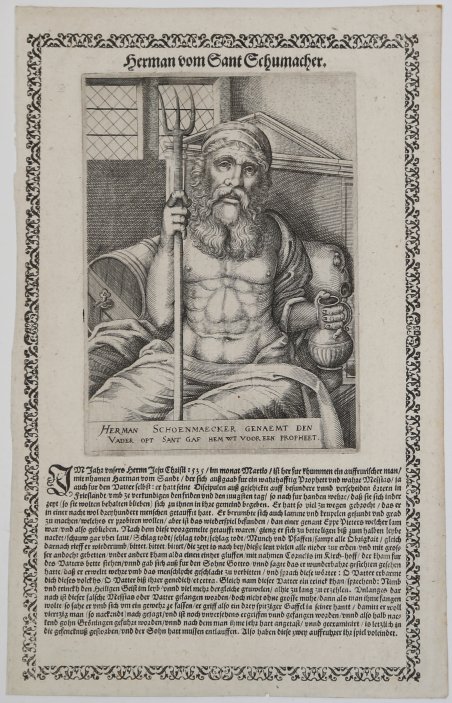
Ritratto di Herman Schoenmaecker
Metodi di Pagamento
- PayPal
- Carta di Credito
- Bonifico Bancario
- Pubblica amministrazione
- Carta del Docente
Dettagli
- Anno di pubblicazione
- 1605
- Formato
- 117 X 165
- Incisori
- SICHEM Christoffel van
- Soggetto
- Ritratti
Descrizione
Bulino, 1605 circa. Da un disegno di Jan Cornelisz Woudanus. Tratto da Historische beschrijvinge ende affbeeldinge der voorneemste hooft ketteren, so vande catholijcke, ende christelijcke kercke[…], pubblicato ad Amsterdam nel 1608 da C. van Sichem. ' Ottimo esemplare, impresso su carta vergata coeva, con filigrana non identificata, in ottimo stato di conservazione. Ritratto di Harm (Harmen) Schoemaker (Schoenmaker), un anabattista olandese. Secondo Hollstein, la lastra fu pubblicata con testo olandese e tedesco, con bordo ornamentale, nelle edizioni del 1608; senza testo e bordo ornamentale, si trova nell'edizione del 1677. Engraving, 1605 circa. Based on a work of Jan Cornelisz Woudanus. ' From Historische beschrijvinge ende affbeeldinge der voorneemste hooft ketteren, so vande catholijcke, ende christelijcke kercke[…], published by C. van Sichem in Amsterdam in 1608. Good example, printed on contemporary laid paper, with unidentified watermark, very good condition. ' According to Hollstein, the plate was published with Dutch and German text, in ornamental border, used in edition of 1608; without text and ornamental border in 1677 edition. Harm (Harmen) Schoemaker (Schoenmaker), a Dutch Anabaptist, who by his unsound bigoted fanaticism (he called himself the Messiah and even God the Father) caused a tumult at 't Zandt, Dutch province of Groningen, in January 1535. On the farm called "De Arke," owned by Eppe Pietersz, a wealthy farmer, a large crowd gathered, over 300 of whom were baptized in one night by Schoenmaker, assisted by Cornelis int Kershof. Schoenmaker was arrested and put in prison in Groningen, where he soon died insane. He clearly took the Münsterite views and initially considered himself an elect to bear the banner of God from Groningen to Münster; i.e., to be the leader of the revolutionary Anabaptists of the Groningen region to the New Zion, which Jan van Leiden had erected in Münster. Cfr.
