Mantua
Mantua
Metodi di Pagamento
- PayPal
- Carta di Credito
- Bonifico Bancario
- Pubblica amministrazione
- Carta del Docente
Dettagli
- Anno di pubblicazione
- 1657
- Luogo di stampa
- Amsterdam
- Formato
- 500 X 365
- Incisori
- JANSSONIUS Johannes
- Descrizione
- D. Ferrari, "Mantova nelle stampe", 27
Descrizione
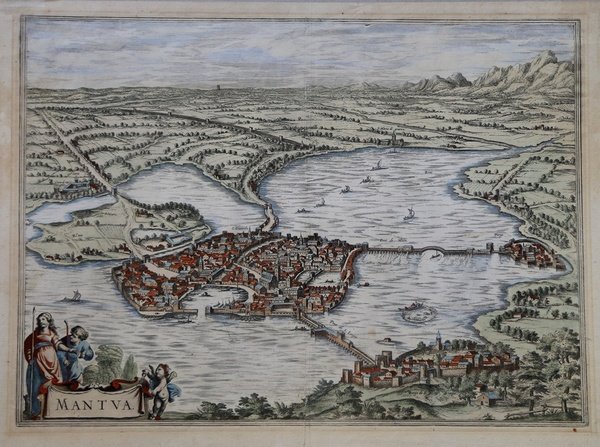
Pianta della città tratta dal "Theatrum praecipuarum urbium" celebre teatro delle città del Janssonius, sullo stile del "Civitates Orbis Terrarum" di Braun & Hogenberg. L'opera, pubblicata nel 1657, contiene 500 tavole raffiguranti città di ogni parte del mondo. Contrariamente al lavoro degli acerrimi rivali della famiglia Blaeu, Janssonius per la realizzazione dell'opera si servì delle lastre di precedenti cartografi ed editori. In particolare, nel 1653 egli acquistò da Abraham Hogenberg le lastre del "Civitates orbis Terrarum" che incorporò nella sua opera, ristampandole. Per le piante delle città olandesi, ordinò delle nuove lastre basate sull'atlante che Johannes Blaeu diede alla luce nel 1649. Per molte delle opere contenute nel 5° volume - quello dedicato all'Italia e denominato "Theatrum celebriorum urbium Italiae." - si servì delle lastre realizzate da Jodocus Hondius per l'opera "Italia Hodierna." del 1627. A differenza di queste ultime il formato è in-folio, con testo sia nel recto che nel verso. Incisione in rame, in ottimo stato di conservazione. Testo latino al verso. Rarissima. City plan taken from "Theatrum praecipuarum urbium", the famous city-plans book realized by Janssonius after Braun & Hogenberg's "Civitates Orbis Terrarum". The work was published in 1657, with 500 plates depicting cities from all over the world. In opposition to his main competitors, the Blaeus, to realize his project, Janssonius used the plates of former cartographers and publishers. In 1653 he bought from Abraham Hogenberg the plates of the "Civitates orbis Terrarum" which have been then included in his work. As far as Dutch cities, he had new plates realized after Johannes Blaeu's Atlas, published in 1649. The plates in the Fifth Volume, the one about Italy entitled "Theatrum celebriorum urbium Italiae.", Janssonius used the plates realized by Jodocus Hondius for his "Italia Hodierna." in 1627. Unlike Hondius' work, Janssonius' is an in-folio size, with text both on recto and on verso. Etching on copperplate with original hand colour, in good conditions. Latin text to the verso. Rare. Cfr. D. Ferrari, "Mantova nelle stampe", 27
