La terrasse de la Villa Brancas
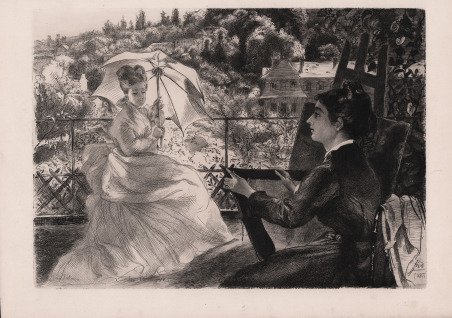
La terrasse de la Villa Brancas
Metodi di Pagamento
- PayPal
- Carta di Credito
- Bonifico Bancario
- Pubblica amministrazione
- Carta del Docente
Dettagli
- Anno di pubblicazione
- 1876
- Formato
- 352 X 252
- Incisori
- BRAQUEMOND Felix
Descrizione
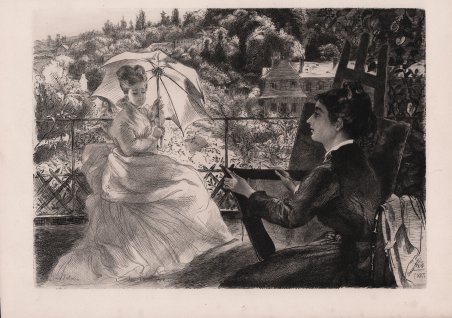
Acquaforte, firmata e datata in basso a sinistra Bracquemond / 1876 / L'Art; nel margine inferiore, nell’immagine, il titolo La Terrasse. In basso a sinistra Imp. Salmon. Esemplare nello stato finale, pubblicato nel periodico L'Art nel 1879 In questa acquaforte del 1876 intitolata La Terrazza, Félix Bracquemond raffigura la moglie Marie mentre dipinge la sorella Louise nella loro prima casa, in Rue Pontin a Sèvres. L’incisione, uno dei lavori più significativi dell’artista, fu eseguita nell’anno della seconda Esposizione Impressionista ed esposta, successivamente, nella quarta. La specificità dell’opera grafica di Bracquemond, che si basa sul rapporto “colore/pittura en plein air”, emerge chiaramente in questa opera, dove l’effetto della luce è magistralmente interpretato nei bianchi dell’abito e dell’ombrellino di Louise, molto luminosi in quanto esposti direttamente al sole, mentre l’abito di Marie è reso con un nero assoluto. ' L’acquaforte suggerisce come già negli anni ‘70 i due coniugi fossero impegnati a meditare su comuni problemi stilistici che avrebbero, tuttavia, imboccato presto percorsi divergenti. L'incisione fu pubblicata nel periodico L'Art nel 1879, anno in cui sia l’autore che la moglie esposero con gli Impressionisti. Bracquemond (Parigi 1833 - ivi 1914), pittore de incisore, che all’inizio della carriera predilesse soggetti di paesaggio e di animali, ispirati agli Olandesi, ma trattati con acuta ricerca della forma e dei rapporti di luce. Notevoli, tra le sue incisioni, i ritratti. Fu tra i primi a sperimentare (1873) la stampa a colori, ispirandosi all'arte giapponese. Si occupò anche dell'incisione su porcellana (come ceramista nelle manifatture di Sèvres) e di arredamento, facendosi promotore, sulla fine del secolo, dell'Art Nouveau. Pubblicò Du dessin et de la couleur (1885) e Étude sur la gravure sur bois et la lithographie (1897). Ottimo stato di conservazione. Bibliografia H. Béraldi, Les graveurs du XIXe siècle: Guide de l'amateur d'estampes modernes, vol. XII, cat. no. 215, pp. 80-81; J. Adhémar, J. Lethève, Inventaire du Fonds Francais Apres 1800, cat. no. 377, p. 381. Etching, signed and dated Bracquemond / 1876 / L'Art inscribed in plate, along bottom: La Terrasse inscribed in plate, lower left: Imp. Salmon. Example of the sixt final state, published in L'Art, 1879. Bracquemond here represents his wife Marie painting her sister outdoors on the terrace of their villa at Sevres. The engraving, one of the artist's most significant works, was executed in the year of the second Impressionist Exhibition and exhibited. The specificity of Bracquemond's graphic work, which is based on the "color/painting en plein air" relationship, clearly emerges in this work, where the effect of light is masterfully interpreted in the whites of Louise's dress and parasol, which are very bright because they are directly exposed to the sun, while Marie's dress is rendered in absolute black. ' The etching suggests that already in the '70s the couple were engaged in meditating on common stylistic problems that would, however, soon take divergent paths. The print was published in the periodical L'Art in 1879, the year that both Marie and Félix exhibited with the Impressionists. Excellent condition. Bracquemond (Paris 1833 - ivi 1914), painter de engraver, who at the beginning of his career preferred subjects of landscape and animals, inspired by the Dutch, but treated with acute research of form and light relationships. Remarkable, among his engravings, the portraits. He was among the first to experiment (1873) the color printing, inspired by Japanese art. He was also involved in the engraving on porcelain (as a ceramist in the manufactures of Sèvres) and furniture, becoming a promoter, at the end of the century, Art Nouveau. He published Du dessin et de la couleur (1885) and Étude sur la gravure sur bois et la lithographie (1897). ' References: H. Béraldi, Les graveurs du XIXe siècle: Guide de l'amateur d'estampes modernes, vol. XII, cat. no. 215, pp. 80-81; ' J. Adhémar, J. Lethève, Inventaire du Fonds Francais Apres 1800, cat. no. 377, p. 381. Cfr.
