Insula Zeilan olim Taprobana nunc incolis Tenarisim
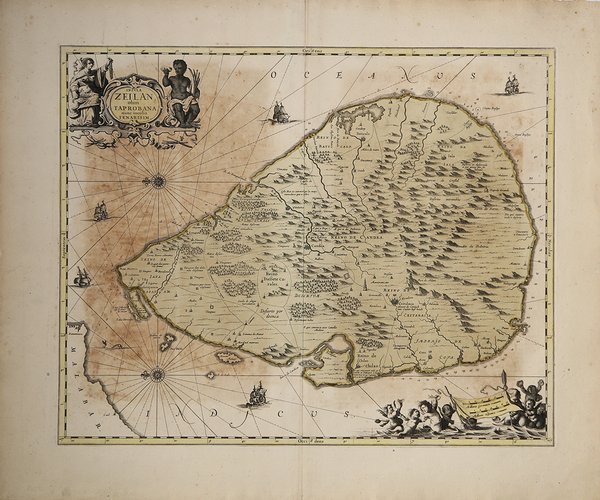
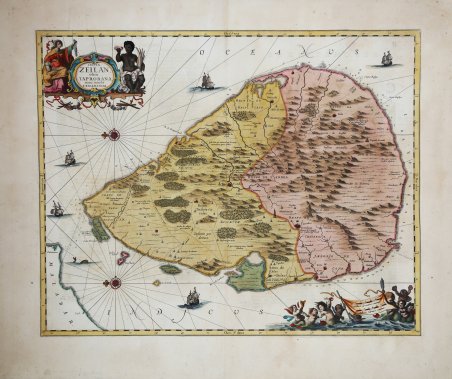
Insula Zeilan olim Taprobana nunc incolis Tenarisim
Metodi di Pagamento
- PayPal
- Carta di Credito
- Bonifico Bancario
- Pubblica amministrazione
- Carta del Docente
Dettagli
- Anno di pubblicazione
- 1650
- Luogo di stampa
- Amsterdam
- Formato
- 510 X 410
- Incisori
- JANSSONIUS Johannes
- Lingue
- Italiano
Descrizione
Carta decorativa dello Sri Lanka, pubblicata nelle edizioni successive dell'atlante di Jansson. Questa superba carta di Ceylon è orientata con il nord a sinistra con due rose di bussola e linee lossodromiche. L'isola è ben delineata con montagne, foreste, strade, città, fortezze e templi. È riccamente abbellita da velieri, un mostro marino e due bei cartigli. Il cartiglio del titolo in alto è affiancato dalla rappresentazione allegorica femminile dell'Asia e da un indigeno che tiene in mano un avorio di elefante. Il cartiglio delle miglia, in basso, è circondato da un gruppo di putti. Johannes Janssonius, figlio dell'editore di Arnhem Jan Janssen, sposò Elisabeth Hondius, figlia di Jodocus Hondius, ad Amsterdam nel 1612. Dopo il suo matrimonio, si stabilì in questa città come libraio ed editore di materiale cartografico. Nel 1618 si stabilì ad Amsterdam accanto alla libreria di Willem Jansz. Blaeu, entrando in una seria competizione. Le sue attività non riguardavano solo la pubblicazione di atlanti e libri, ma anche di mappe singole e un vasto commercio di libri con filiali a Francoforte, Danzica, Stoccolma, Copenaghen, Berlino, Koningsbergen, Ginevra e Lione. Nel 1631 iniziò a pubblicare atlanti insieme a Henricus Hondius. Nei primi anni 1640 Henricus Hondius lasciò l'attività di pubblicazione di atlanti completamente a Janssonius. La concorrenza con Joan Blaeu, figlio e successore di Willem, nella produzione di atlanti spinse Janssonius ad ampliare il suo Atlas Novus finalmente in un'opera di sei volumi, in cui furono inseriti un atlante marino e un atlante del Vecchio Mondo. Dopo la morte di Joannes Janssonius, il negozio e la casa editrice furono continuati dagli eredi sotto la direzione di Johannes van Waesbergen (c. 1616-1681), genero di Joannes Janssonius. Le matrici degli atlanti di Janssonius furono in seguito vendute a Schenk e Valck. Incisione in rame coloritura coeva con ritocchi, in ottime condizioni. Rara. Decorative map of Sri Lanka, published in the later editions of Jansson's atlas. This superb map of Ceylon is oriented with north to the left with two compass roses and rhumb lines. The island is well delineated with mountains, forests, roads, cities, forts, and temples. It is richly embellished with sailing ships, a sea monster and two fine cartouches. The title cartouche at top is flanked by the allegorical female representation for Asia and a native holding elephant ivory. The scale of miles cartouche at bottom is surrounded by a group of adorable putti. Johannes Janssonius (Arnhem, 1588-1664), son of the Arnhem publisher Jan Janssen, married Elisabeth Hondius, daughter of Jodocus Hondius, in Amsterdam in 1612. After his marriage, he settled down in this town as a bookseller and publisher of cartographic material. In 1618 he established himself in Amsterdam next door to Blaeu’s book shop. He entered into serious competition with Willem Jansz. Blaeu. His activities not only concerned the publication of atlases and books, but also of single maps and an extensive book trade with branches in Frankfurt, Danzig, Stockholm, Copenhagen, Berlin, Koningsbergen, Geneva, and Lyon. In 1631 he began publishing atlases together with Henricus Hondius. In the early 1640s Henricus Hondius left the atlas publishing business completely to Janssonius. Competition with Joan Blaeu, Willem’s son and successor, in atlas production prompted Janssonius to enlarge his Atlas Novus finally into a work of six volumes, into which a sea atlas and an atlas of the Old World were inserted. After the death of Joannes Janssonius, the shop and publishing firm were continued by the heirs under the direction of Johannes van Waesbergen (c. 1616-1681), son-in-law of Joannes Janssonius. The copperplates from Janssonius’s atlases were afterwards sold to Schenk and Valck. Copperplate, with original colour with retouches, very good condition. Cfr.
