Il Pont Neuf a Parigi
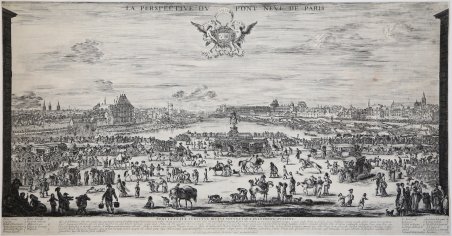
Il Pont Neuf a Parigi
Metodi di Pagamento
- PayPal
- Carta di Credito
- Bonifico Bancario
- Pubblica amministrazione
- Carta del Docente
Dettagli
- Anno di pubblicazione
- 1646
- Formato
- 685 X 360
- Incisori
- Della BELLA Stefano
Descrizione
Acquaforte, 1646, firmata e datata in lastra in basso. Esemplare nel rarissimo primo stato di quattro, avanti il gallo sopra il campanile della chiesa di San Germain de L’Auxerrois. Magnifica prova, ricca di toni, impressa su carta vergata coeva, rifilata al rame o con sottilissimi margini, piccole abrasioni visibili al verso, per il resto in ottimo stato di conservazione. La veduta di Parigi presa dal Ponte Neuf rappresenta uno dei capolavori di Stefano della Bella. La tavola, la più grande dell’autore, è straordinariamente animata da centinaia di personaggi e animali in un grande intreccio di scene di vita quotidiana. Massar descrive solo due stati dell’opera, ampliati a quattro da Silverio Salamon. Il primo stato, indicato come raro, si riconosce per l’assenza del piccolo gallo sul campanile della chiesa indicata nella legenda con il numero 8, cosa che, secondo Massar, potrebbe non essere causata direttamente dalla stampa ma da qualcuno che avrebbe “grattato” l’opera. ' Stefano della Bella fu uno degli incisori più interessanti e originali nella Firenze del XVII secolo e può considerarsi l’unico geniale continuatore dell’opera di Jacques Callot. La sua educazione artistica ebbe inizio a Firenze nella bottega degli orafi Gasparo Mola e Orazio Vanni, e la precisione del segno, tipica dell’arte orafa resterà caratteristica del suo stile. Studiò poi presso Giovanni Battista Vanni e forse anche presso il Cantagallina e Cesare Dandini, ma ben presto si dedicò all'incisione. Il suo vero maestro può considerarsi Jacques Callot, l’incisore francese che soggiornò a lungo a Firenze lasciando una forte impronta nel panorama artistico della città. Gli anni più importanti della sua carriera sono quelli che trascorre a Parigi, dal 1639 al 1650, stipendiato da Lorenzo de' Medici: lavorò insieme ad Israel Silvestre, con gli editori Langlois, Ciartres e Pierre Mariette, per stampatori francesi e per commissioni di gran prestigio, come quelle del 1641 per il cardinale Richelieu che gli affidò le illustrazioni delle sue imprese guerresche. Intorno al 1647, durante un viaggio in Olanda, dove eseguì le acqueforti con le vedute del porto di Amsterdam, incontrò Rembrandt e da quella data notiamo una eco profonda dell’arte dell’olandese nella grafica del Della Bella. Bibliografia De Vesme-Massar 850 I/II; Salamon, ' Stefano della Bella, 169-71 I/IV. Etching, 1646, signed and dated in the plate at the bottom. Rare example of the first state of four, before the cock on the steeple of the church of St. Germain L' Auxerrois. Magnificent proof, rich in shades, printed on contemporary laid paper, trimmed to the copperplate or with very thin margins, small abrasions visible on the verso, otherwise in excellent condition. The view of Paris taken from the Pont Neuf is one of the masterpieces of Stefano della Bella and his biggest plate. The table is extraordinarily animated with hundreds of characters and animals, a great mix of scenes of everyday life in a grid. Massar describes only two states of the work expanded to four by Silverio Salamon. The first state, referred to as rare, it is recognized by the absence of the small cock on the steeple of the church indicated in the legend with the number 8. The Massar warning collectors to verify that the absence of the cock has not been caused directly in printing, scratching the work. Stefano della Bella was one of the most interesting and original engravers in 17th-century Florence and can be considered the only brilliant continuator of Jacques Callot's work. His artistic education began in Florence in the workshop of the goldsmiths Gasparo Mola and Orazio Vanni, and the precision of sign, typical of the goldsmith's art, will remain characteristic of his style. He then studied under Giovanni Battista Vanni and perhaps also under Cantagallina and Cesare Dandini, but soon turned to engraving. His real master can be considered Jacques Callot, the French engraver who stayed in Florence for a long time and left a strong imprint on the city's artistic scene. The most important years of his career were the ones he spent in Paris, from 1639 to 1650, salaried by Lorenzo de' Medici: he worked together with Israel Silvestre, with the publishers Langlois, Ciartres and Pierre Mariette, for French printers and for commissions of great prestige, such as those of 1641 for Cardinal Richelieu, who entrusted him with illustrations of his warlike exploits. Around 1647, during a trip to Holland, where he executed etchings with views of the port of Amsterdam, he met Rembrandt, and from that date we note a profound echo of the Dutchman's art in Della Bella's graphic work. Magnificent example of this rare and spectacular engraving. Bibliografia De Vesme-Massar 850 I/II; Salamon, Stefano della Bella, 169-71 I/IV. Cfr.
