Il martirio di S. Erasmo
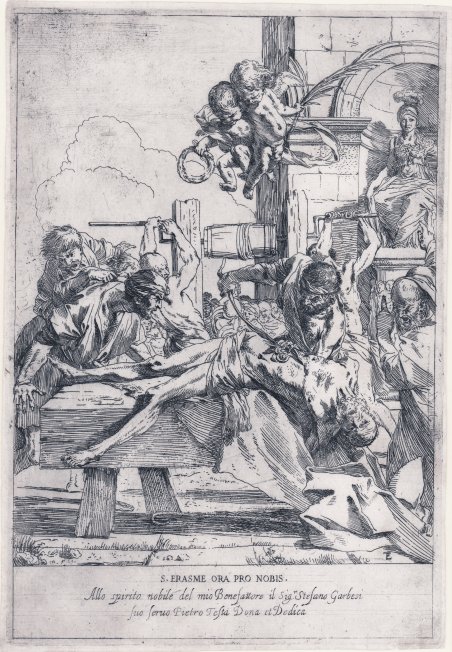
Il martirio di S. Erasmo
Metodi di Pagamento
- PayPal
- Carta di Credito
- Bonifico Bancario
- Pubblica amministrazione
- Carta del Docente
Dettagli
- Anno di pubblicazione
- 1630
- Formato
- 190 X 280
- Incisori
- TESTA detto "Il Lucchesino" Pietro
Descrizione
Acquaforte, circa 1630, monogrammata in lastra in basso a destra. Esemplare nel secondo stato di cinque, avanti l’indirizzo di Giacomo de’Rossi. Magnifica prova, ricca di toni, impressa su carta vergata coeva con filigrana “ancora nel cerchio e stella” (Briquet 488), con sottili margini, leggera abrasione all’angolo inferiore destro, per il resto in ottimo stato di conservazione.Il Martirio di S. Erasmo costituisce il primo incarico pubblico di Nicolas Poussin a Roma, ove il pittore francese si era trasferito nel 1624. Eseguito per l'altare del transetto destro della Basilica di S. Pietro nel quale si conservavano le reliquie del Santo, il dipinto vi rimase fino al Settecento, allorché fu sostituito da una copia in mosaico e trasferito nel palazzo pontificio del Quirinale. Fonti degne di fede attestano l'esistenza di un S. Erasmo, martire, vescovo di Formia, il cui culto era molto diffuso nella Campania e nel Lazio. Il nome di Erasmo, oltre che nei martirologi storici, donde è passato nel Romano, era inserito nel Calendario marmoreo di Napoli. Nell'842, dopo che Formia era stata distrutta dai Saraceni, le sue reliquie vennero trasferite a Gaeta e nascoste in un pilastro della chiesa di S. Maria, dove furono rinvenute nel 917 dal vescovo Bono. Da quel tempo Erasmo fu proclamato patrono di Gaeta e furono anche coniate monete con la sua effigie. Il 3 febbraio 1106 Pasquale II consacrò la cattedrale di Gaeta in onore della Vergine e di Erasmo Nel Medio Evo il santo fu annoverato tra i cosiddetti santi Ausiliatori e invocato specialmente contro le epidemie, mentre i marinai lo venerano come patrono col nome di S. Elmo. La vicenda artistica di Pietro Testa, detto il Lucchesino dalla sua città d’origine, è assai tormentata. Poco o nulla si sa del suo primo apprendistato nella città natale. Arrivato a Roma nel 1629, fu probabilmente dapprima a scuola presso il Domenichino, poi presso la bottega di Pietro da Cortona, suo vero maestro. Il carattere introverso dell’artista gli procurò comunque sempre difficoltà con ' i suoi colleghi: il Cortona infatti fu costretto a cacciarlo dalla sua scuola per l’atteggiamento di sprezzante superiorità assunta dall’allievo . Il Testa frequentò allora la casa del suo primo mecenate, il celebre collezionista Cassiano del Pozzo, per il quale eseguì disegni dall’antico. Fu probabilmente nella sua casa che conobbe il pittore Nicolas Poussin, che influenzerà profondamente la sua arte sia nella sua prima fase di adesione tizianesca ' al movimento neo-veneto, sia nel periodo più maturo, a partire dagli anni 1635 in poi, caratterizzati da un intellettualismo classicheggiante. Resta comunque il fatto che le sue incisioni (che ammontano a 40 tavole circa) furono considerate fin dall’antichità, a partire dal Sandrart e dal Baldinucci, le opere grafiche più importanti del '600 italiano. Etching, circa 1630 monogrammed in plate lower right. Example of the second state of five, before the address of Giacomo de 'Rossi. Magnificent proof, rich tones, printed on contemporary laid paper with watermark "still in the circle and star" (Briquet 488), with thin margins, slight abrasion to the lower-right corner, otherwise in excellent condition. The Martyrdom of St. Erasmus is the first public office of Nicolas Poussin in Rome, where the French painter had moved in 1624. Performed for the altar of the right transept of St. Peter's Basilica in which were preserved the relics of the saint, the painting remained there until the eighteenth century, when it was replaced by a copy in mosaic and transferred to the papal palace of the Quirinal. Reliable sources attest to the existence of a St. Erasmus, Martyr, Bishop of Formia, whose cult was widespread in Campania and Lazio. The name of Erasmus, as well as in historical martyrdoms, whence it passed into the Roman Empire, was inserted into the marble calendar of Naples. In 842, after Formia had been destroyed by the Saracens, his relics were transferred to Gaeta and hidden in a pillar of the church of St. Mary, where were discovered in 917 by Bishop Bono. Since that time Erasmus was proclaimed patron of Gaeta and were also minted coins with his effigy. On February 3, 1106 Paschal II consecrated the cathedral of Gaeta in honor of the Virgin and of Erasmus In the Middle Ages, the saint was counted among the so-called saints Helpers and especially invoked against epidemics, while the sailors revere him as a patron by the name of St. Elmo. Pietro Testa was called Lucchesino for he was born in Lucca. There are but a few news about his apprenticeship in his hometown; for sure, he went to Rome in 1629 to study in the school of Domenichino first and then, towards the end of the year, he moved to the studio of his real master, Pietro da Cortona. His introvert temper caused him a lot of troubles; Cortona, in fact, was obliged to send him away due to his hostile and disdainful behaviour. Testa went then to the house of his first patron, the famous collector Cassiano del Pozzo, and for him he realized his drawings from antiques. Maybe it was in this house that he met Nicolas Poussin who deeply influenced his art both in the neo-Venetian phase and the intellectual classicist one, from 1635. His engravings though, about 40 pieces, have been considered, starting from Sandrart and Bladinucci, the most important graphic works of the Italian XVII century. Cfr. Bartsch 14; Bellini 7; TIB 014 II/V.; Cropper, 6
