Altro diletto che imparar non trovo
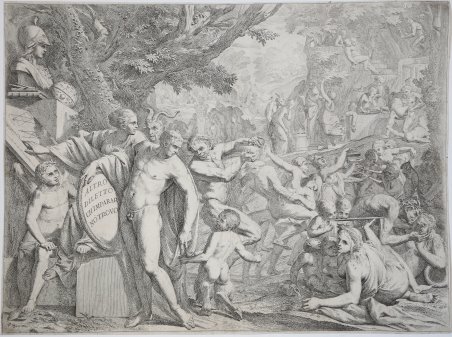
Altro diletto che imparar non trovo
Metodi di Pagamento
- PayPal
- Carta di Credito
- Bonifico Bancario
- Pubblica amministrazione
- Carta del Docente
Dettagli
- Anno di pubblicazione
- 1645
- Formato
- 460 X 338
- Incisori
- TESTA detto "Il Lucchesino" Pietro
Descrizione
Un giovane uomo al servizio delle Virtù e della Scienza, nota anche come Altro diletto che imparar non trovo.Acquaforte, circa 1645-50, firmata in lastra in basso a sinistra. Esemplare nel primo stato di tre, avanti l’indirizzo del Westerouth. Bellissima prova, impressa su carta vergata coeva con filigrana, rifilata alla linea marginale, tracce di pieghe di carta al verso, piccoli restauri perfettamente eseguiti, nel complesso in ottimo stato di conservazione. Il soggetto di questa stampa, di una complessa allegoria, riflette la concezione del diletto o piacere intellettuale del Testa, nelle sembianze del giovane eroe nudo e puro, che impersona il pittore-filosofo descritto da Vitruvio. Come sottolinea la Cropper, l’ispirazione di questa scena è classica. In particolare, il giovane deriva dalla statua di Mercurio di François Duquesnoy, ed entrambe si rifanno all’Antinoo del Belvedere.La concezione del diletto qui raffigurata riprende la teoria aristotelica per la quale l’uomo tende alla conoscenza secondo un processo intellettuale che Testa considera assolutamente positivo e puro, lontano dai piaceri mondani e dei sensi, rappresentati dalle figure dei satiri e delle baccanti, sulla destra.Il Diletto è raffigurato, in posa eroica, ai piedi della statua di Minerva, dea della sapienza, con accanto libri, un globo celeste e una grande tavola di studi planimetrici, in omaggio alla convinzione di Vitruvio per cui lo studio si basa su principi architettonici e matematici.Il motto Altro Diletto ch’imparar non trovo, che si legge sullo scudo è una citazione colta dal Trionfo dell’Amore di Petrarca, tratta dall’edizione di Vitruvio.Ad oggi, non sono noti disegni preparatori per quest’incisione, che per stile e padronanza del chiaroscuro è affine alle tavole delle Stagioni e perciò databile intorno al 1644. La vicenda artistica di Pietro Testa, detto il Lucchesino dalla sua città d’origine, è assai tormentata. Poco o nulla si sa del suo primo apprendistato nella città natale. Arrivato a Roma nel 1629, fu probabilmente dapprima a scuola presso il Domenichino, poi presso la bottega di Pietro da Cortona, suo vero maestro. Il carattere introverso dell’artista gli procurò comunque sempre difficoltà con ' i suoi colleghi: il Cortona infatti fu costretto a cacciarlo dalla sua scuola per l’atteggiamento di sprezzante superiorità assunta dall’allievo . Il Testa frequentò allora la casa del suo primo mecenate, il celebre collezionista Cassiano del Pozzo, per il quale eseguì disegni dall’antico. Fu probabilmente nella sua casa che conobbe il pittore Nicolas Poussin, che influenzerà profondamente la sua arte sia nella sua prima fase di adesione tizianesca ' al movimento neo-veneto, sia nel periodo più maturo, a partire dagli anni 1635 in poi, caratterizzati da un intellettualismo classicheggiante. Resta comunque il fatto che le sue incisioni (che ammontano a 40 tavole circa) furono considerate fin dall’antichità, a partire dal Sandrart e dal Baldinucci, le opere grafiche più importanti del '600 italiano. A young man in the service of Virtue and Science, also known as Altro diletto che imparar non trovo.Etching, circa 1645-50, signed in the plate in the bottom left corner. Example in the first state of three, before the address of Westerouth. Excellent work, printed on contemporary laid paper with unidentified watermark, trimmed to the borderline, traces of folds of paper on verso, small restorations perfectly executed, otherwise in excellent condition. The subject of this work, a complex allegory reflects the conception of pleasure or intellectual pleasure of the head, in the likeness of the young hero naked and pure, who plays the painter-philosopher described by Vitruvius. As emphasized in the Cropper, the inspiration of this scene is classic. “The motto of this etching – “I find delight only in learning” – pertectly expresses Testa’s own philosophy of pleasure. The heroic nude who supports shield on which it is written personifies the ideal Vitruvian philosopher-painter he sought to be. The from Petrarch's Triumph of Love, which Testa found in the pages of Daniele Barbaro's edition of Vitruvius, which was perhaps the book he most closely srudied. In book one, chapter two, of his Ten Books f Architecture Vitruvius enumerates the principles of architecture, considering in their turn order, arrangement, curhythmy, symmetry, propriety, and economy. The second principle, arrangement, con- cerns ground plan, elevation, and perspective, all of which are born, according to Vitruvius, of reflection and invention. Reflection (pensamento), in turn, involves study, industry, and vigilance, all combined delight (dilettatione). In Testa's image the bust of Minerva, accompanied by books, compasses, and a celestial globe, broadly indicates that the artist- hero is being drawn toward wisdom; but the draw- ings on the tablet below, including the profile of a cornice, a line marked off into sections, a geometri- cal diagram, and the elevation of a cone, make it clear that Testa's invocation to artistic virtue is founded on Vitruvius's discussion of architectural say?ng is not of his own invention but is a quotation principles. In commenting on this passage in his second edition and translation of I dieci libri, pub- lished in 1567, Barbaro expands upon Vitruvius's notion of the delight and pleasure that accompany beautiful things born of hard work and diligence. He writes that pleasure follows the fulfillment of desire and that because the intellect desires the truth the greatest delight is to be found in learning it, "whence one says, 'I find delight only in learning. Barbaro's quotation in this way of a verse from Petrarch's Triumph of Love led to its becoming a kind of artist's motto. It was employed not only by Testa but also by the English architect Inigo Jones on the hrst page of his Roman sketchbook in 1614 The Florentine painter Alessandro Allori also added it to his signature on The Sacrifice of Isaac, dated 1601, now in the Uffizi.' […] This etching is very similar in technique and in invention to "The Seasons" and probably dates to about 1644. No preparatory drawings are known, and despite the in- scription there is no evidence that Testa produced a painting of this subject.' Altro diletto continues the investigation, begun in The Triumph of Painting on Parnassus of the artist's own struggle for virtue, framed without the reference to the natural order that characterizes "The Seasons." What further distinguishes these two prints and The Triumph of the Virtuous Artist on Parnassus from "The Seasons" is the prominence given to models taken from ancient sculpture and not only ' to Testa's study of figures from Annibale Carracci The figure of the young man is derived from the famous statue of Mercury by François Duquesnov itself closely modeled on the Belvedere Antinous that Testa would have known well. The sculpture was reproduced in the two-volume Galleria Giustiniani (Rome, 1631-c. 1634), the lavish publication . Cfr. Bartsch, 32; Bellini, 34 I/III; Cropper, n. 101; Massari, Tra Mito e Allegoria, p. 538, 221.
