Ovidii Nasonis Opera Daniel Heinsis textum recensuit.
Ovidii Nasonis Opera Daniel Heinsis textum recensuit. | Libri antichi e moderni | OVIDIUS, Publius Naso (43 BC - 17 CE)-HEINSIUS, Daniel, ed. (1
Ovidii Nasonis Opera Daniel Heinsis textum recensuit.
Ovidii Nasonis Opera Daniel Heinsis textum recensuit. | Libri antichi e moderni | OVIDIUS, Publius Naso (43 BC - 17 CE)-HEINSIUS, Daniel, ed. (1
Metodi di Pagamento
- PayPal
- Carta di Credito
- Bonifico Bancario
- Pubblica amministrazione
- Carta del Docente
Dettagli
- Anno di pubblicazione
- 1629
- Luogo di stampa
- Leiden
- Autore
- OVIDIUS, Publius Naso (43 BC - 17 CE)-HEINSIUS, Daniel, ed. (1
- Editori
- Ex officina Elzeviriana
- Soggetto
- Miscellanea di opere minori
- Stato di conservazione
- Buono
- Lingue
- Italiano
- Legatura
- Rilegato
- Condizioni
- Usato
Descrizione
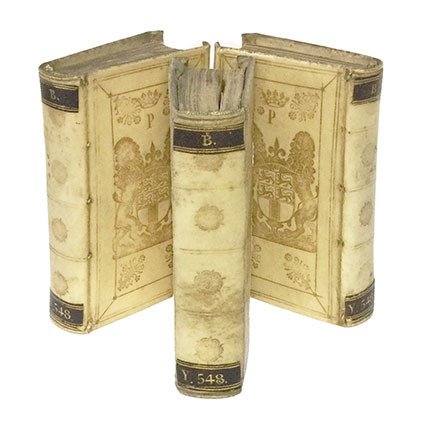
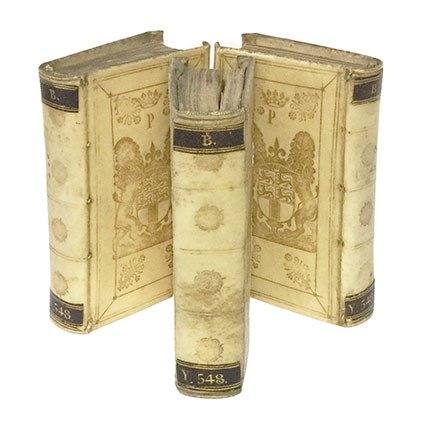
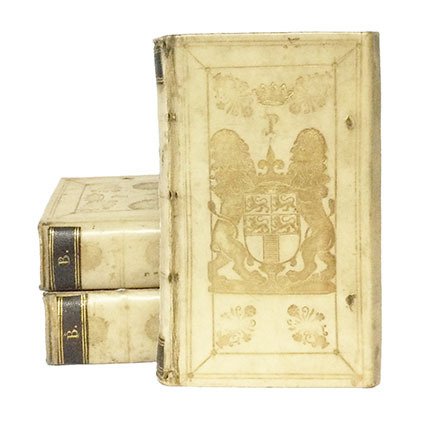
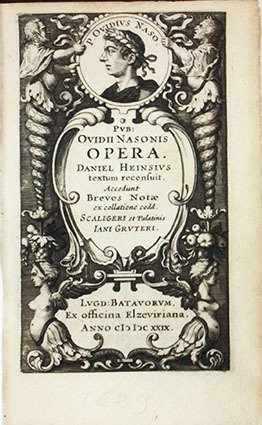
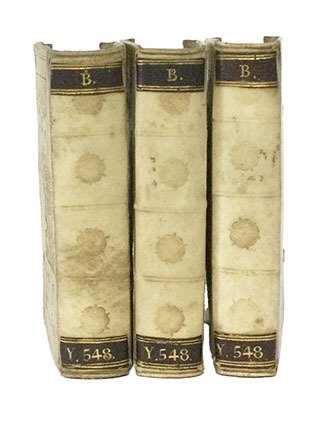
Three volumes, 12mo (125 x 73 mm). Volume 1: [24], 344 pp. 8* A-Y⁸. Volume 2: [16], 442 (wrongly numbered 444), [6] pp. 8* A-Z ⁸ Aa-Ee⁸ . Volume 3: [12], 420 pp. 6* a-z⁸ aa-cc⁸ dd² (quire g misbound). Contemporary stiff vellum: premium binding enriched by two gilt concentric frames and a bipartite shield bearing four lions passant at the head, flanked by a pair of rampant lions, the coat-of-arms of the city of Rotterdam, where the production of premium bindings was divided between the workshops of the Bloemenvaas group and Hertenbinderji, smooth spine with four gilt ornamental flowers and shelf marks ("B." and "Y.548") on black labels (signs of ties, brownish or red sealing-wax stains only on the cover of volume two). Armorial bookplate of Welbeck Abbey (historic country house near the village of Welbeck in the Bassetlaw District of Nottinghamshire), same engraved coat-of-arms on the front pastedown and flyleaf of volume one, belonging to the Sixth Duke of Portland William Arthur K.G. Engraved architectural title page in volume one, woodcut printer's device on the title page of volume two and three; woodcut historiated initials, head and tail pieces. Slightly browned and with minor marginal stains, bookblock of volume two partially detached from the binding, overall a good, genuine copy.
First Elzevier edition edited by Daniel Heinsius of Ovid's collected works. Editor's dedication to Adriaan van Blyenbergh (Dutch nobleman, jurist and high magistrate who lived between the late 16th and early 17th century, known as Lord of Naaldwij and Praetor of Dordrecht) opening volume one. Daniel Heinsius was one of the most distinguished intellectuals of the Dutch Golden Age, a renowned scholar, poet, theologian, and classical philologist whose influence extended across Europe. Born in Ghent and later active in Leiden, he became a professor at the University of Leiden at a remarkably young age and earned international recognition for his mastery of Greek, Latin, and classical literature. Heinsius was especially admired for his editions and commentaries on ancient authors such as Aristotle, Horace, and Virgil, helping shape the study of classical texts in early modern Europe. Alongside his academic work, he wrote elegant Neo-Latin poetry and Dutch verse, combining Renaissance humanism with the intellectual spirit of the Protestant Netherlands. His correspondence and scholarship connected him with many of the leading thinkers of the 17th century, making him a central figure in European humanist culture.
Volume three begins with Angelo Poliziano's (one of the leading humanists of the Italian Renaissance, a poet, classical scholar, and close associate of the Medici court in Florence, he became famous for his elegant Latin and Italian writings and for his pioneering studies of ancient Greek and Roman texts) Elegia de exilio et morte Ovidi, a touching poem celebrating Ovid misterious exile by Emperor Augustus in CE. The volume also collects the notes of Joseph Justus Scaliger (1540–1609), known in Italian as Giuseppe Flavio Giusto Scaligero, one of the greatest Renaissance scholars and philologists of early modern Europe. Born in Agen, France, he became famous for revolutionizing the study of ancient history, chronology, and classical texts. Scaliger possessed an extraordinary command of languages, including Greek, Latin, Hebrew, and several Eastern languages, which allowed him to compare ancient sources with unprecedented precision. His groundbreaking works on chronology helped historians reconcile Greek, Roman, Persian, Jewish, and Egyptian timelines, fundamentally transforming historical scholarship. In 1593 he accepted a prestigious appointment at the University of Leiden in the Dutch Republic, where he spent the rest of his life and became one of the intellectual giants of the European Republic of Letters.
Born in Sulmona, east of Rome, into a wealthy equestrian family, Ovid was educated in rhetoric and law but soon abandoned a political