Les recherches et antiquitez de la Ville et Université de Caen, & lieux circonvoisins des plus remarquables
Les recherches et antiquitez de la Ville et Université de Caen, & lieux circonvoisins des plus remarquables | Libri antichi e moderni | BORGUEVILLE, Charles de (1504-1593)
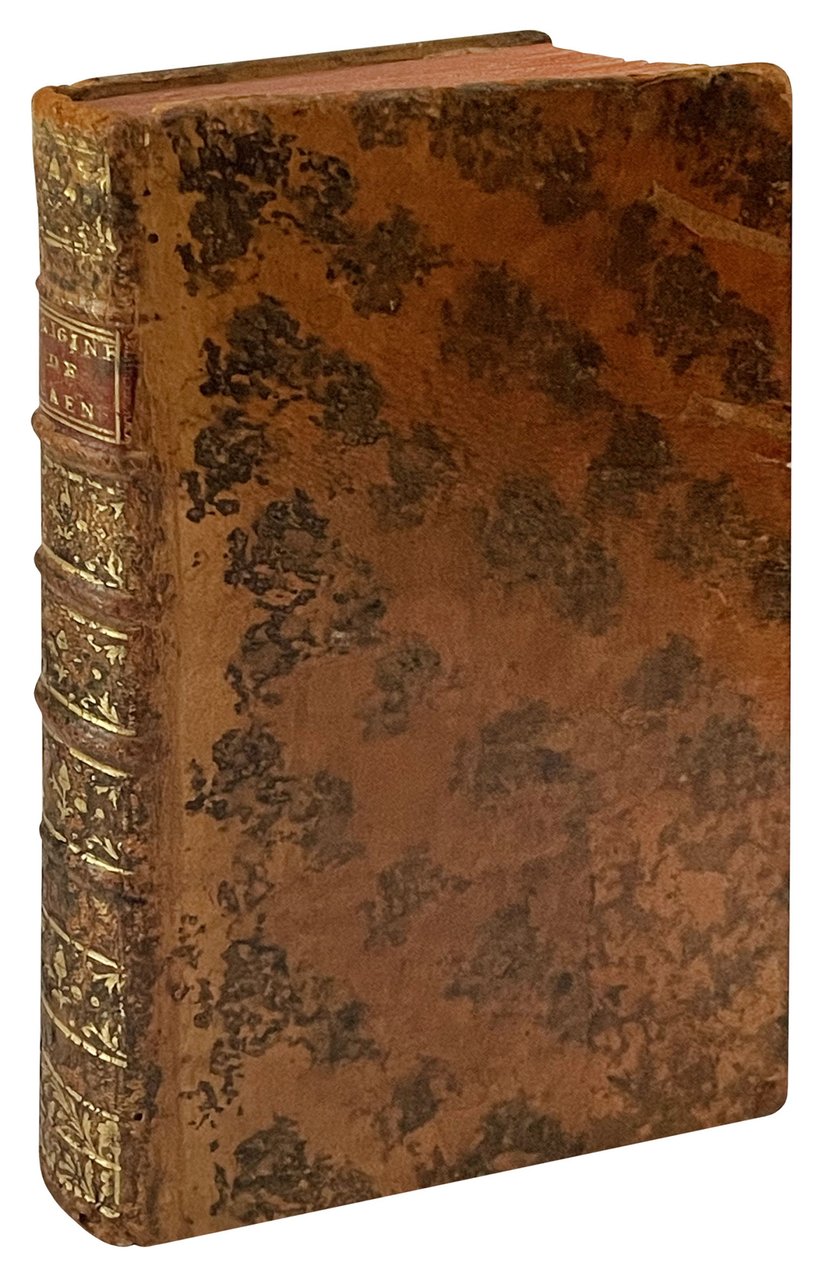
Les recherches et antiquitez de la Ville et Université de Caen, & lieux circonvoisins des plus remarquables
Les recherches et antiquitez de la Ville et Université de Caen, & lieux circonvoisins des plus remarquables | Libri antichi e moderni | BORGUEVILLE, Charles de (1504-1593)
Metodi di Pagamento
- PayPal
- Carta di Credito
- Bonifico Bancario
- Pubblica amministrazione
- Carta del Docente
Dettagli
- Anno di pubblicazione
- 1588 [i.e. 1750]
- Luogo di stampa
- Caen
- Autore
- BORGUEVILLE, Charles de (1504-1593)
- Editori
- Jean de Feure [recte Pierre Chalopin]
- Soggetto
- settecento
- Stato di conservazione
- Buono
- Lingue
- Italiano
- Legatura
- Rilegato
- Condizioni
- Usato
Descrizione
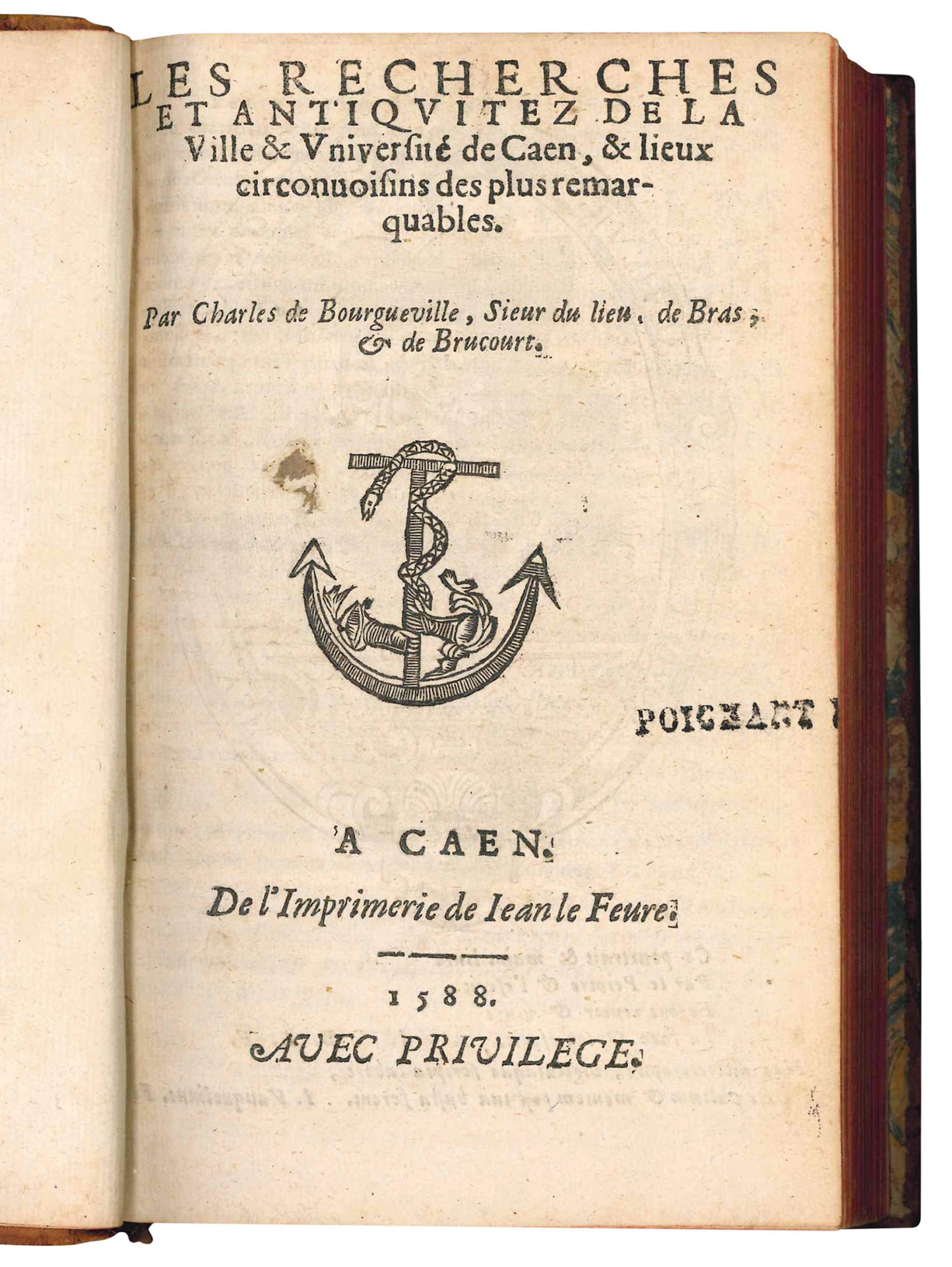
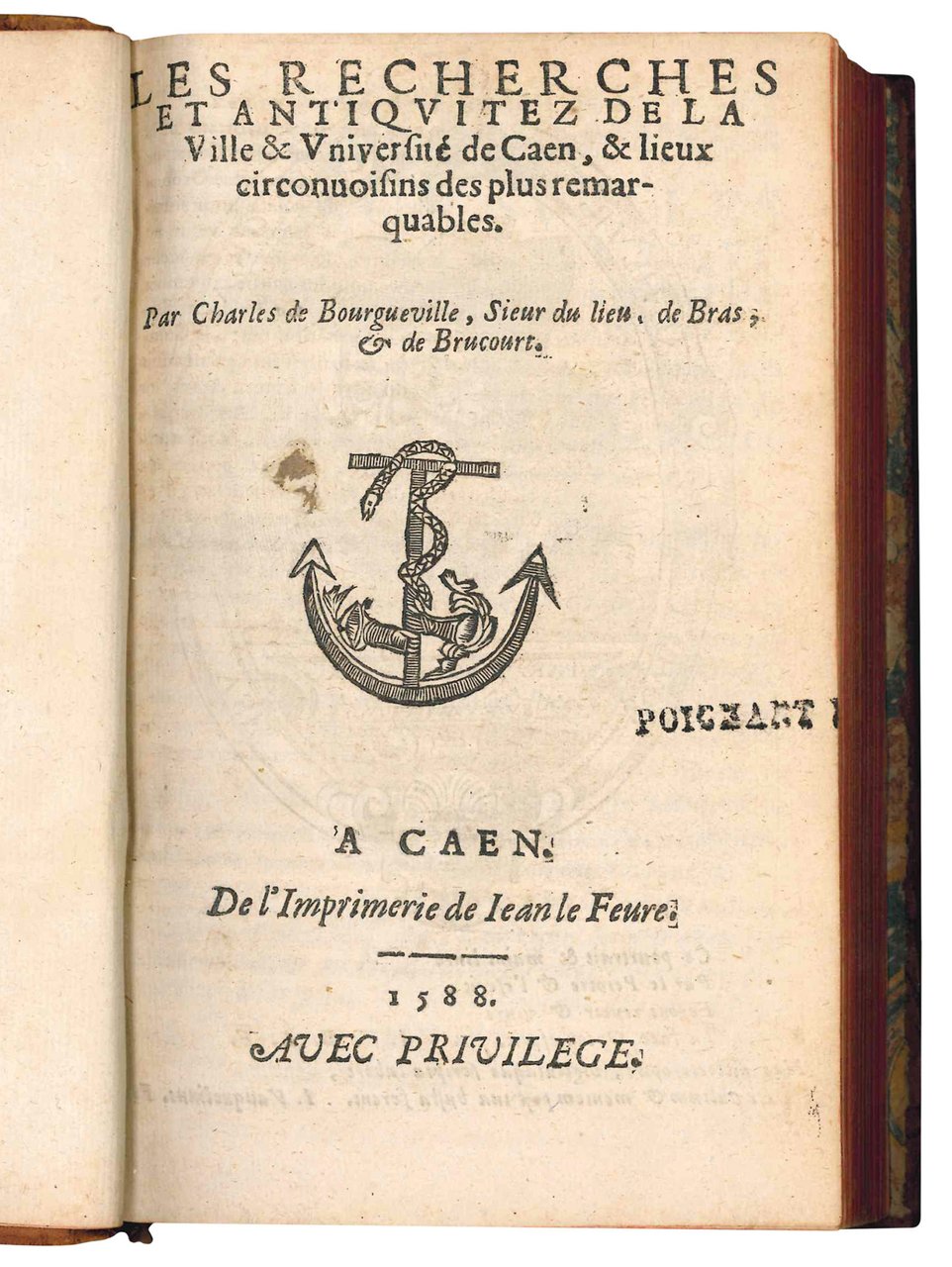
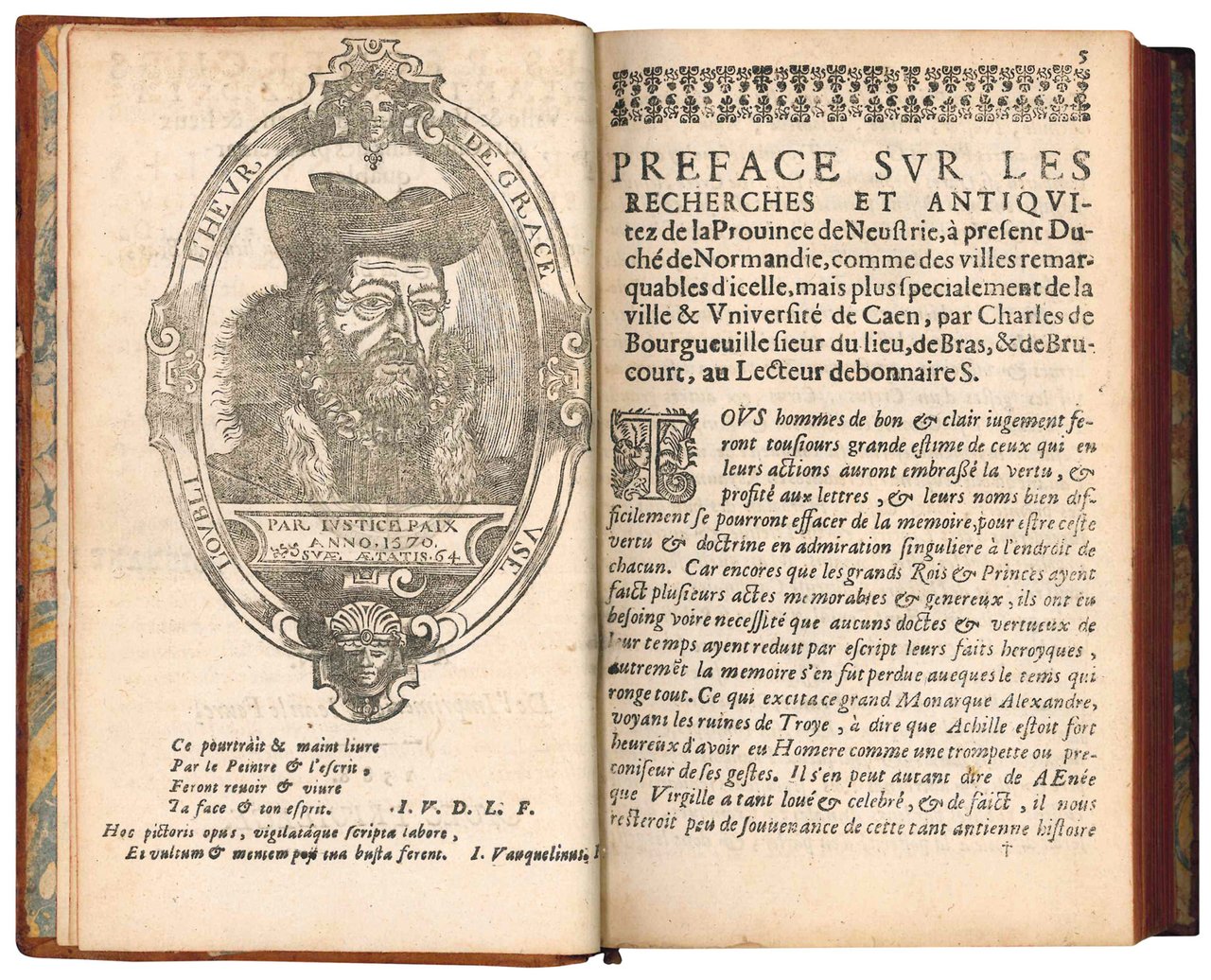
Two parts in one volume, 8vo (192x113 mm). [8], 65, [7] pp.; [2], 263, [1] pp. Collation: ♰⁴, A-I⁴; [π]¹, A⁴, Bb-Zz⁴, Aaa-Kkk⁴. Contemporary marbled calf binding (worn and rubbed). Gilt title on marocco lettering piece, decorations and raised bands on spine. Red edges. Woodcut printer's device of De Feure on the title page. Author's woodcut portrait at title-page verso. Several woodcut historiated initials, head- and tail-pieces. Margins cut short (not affecting current titles or text), uniformly browned, repair to the outer margn of leaf [π]1 slightly affecting the text, but overall a decent copy.
Counterfeit of the 1588 edition issued Pierre Chalopin around 1750. Édouard Frère reports, in his Manuel du bibliographe normand, that, for a reason now unknown, the author's family had a large number of copies of this book destroyed after his death, "so that in a few years, it became extremely rare." This reprint mimickes the structural two-part division of the original and even reproduces the engraved portrait of Bourgueville. Despite Charlopin's deceiving attempt, the differences in paper stock, types, and ornaments between the original edition and his counterfeit stand out immediately. "At the beginning of the 18th century (in 1705), two printings of this book appeared, one in-8vo and the other in-4to, both bearing the date 1588. It is easy to immediately recall these contrasts: the distinction between the forms of the type, which is finer and clearer, due to the uneven printing, and the gray letters, intaglios, and vignettes that are either lacking or less pure in style. The in-8vo edition bears on the title: "De l'Imprim. de Jean Le Feure," instead of "Jean de Feure," and it contains no marginal notes".
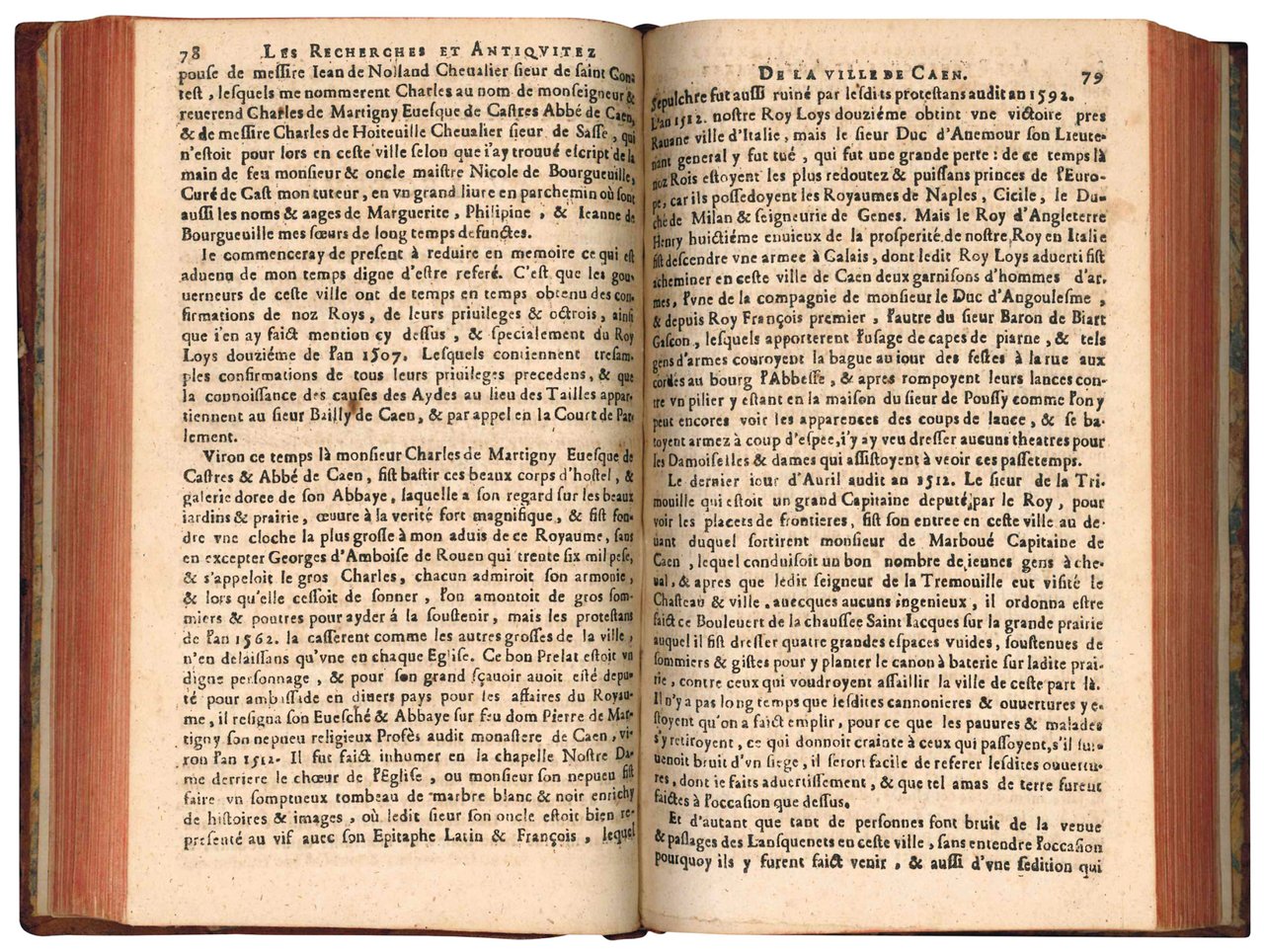
Charles de Bourgueville was a high-ranking local magistrate, the Lieutenant-Général of the Bailliage of Caen. Consequently, his work as more of the view of a personal inhabitant of the city. The text opens with an invaluable urbanistic and architectural survey of medieval and Renaissance Caen, offering a record of historic structures that would later be altered. He details the spatial footprints, institutional privileges, and contemporary structural conditions of monumental landmarks such as the Abbaye-aux-Hommes and the Abbaye-aux-Dames. Furthermore, Bourgueville maps out the civic topography of the city, tracing the development of defensive fortifications, municipal gates, and the shifting banks of the Orne and Odon rivers, while dedicating significant space to defending the intellectual prestige and administrative charters of the University of Caen, which had been founded during the English occupation by John of Lancaster, in 1432, in order to educate the Norman speaking class in French soil. In the 16th century, precisely at the time Charles de Bourgueville wrote, the University of Caen became a nerve center of ideological conflict. Thanks to its intellectual vitality, the faculty became one of the main strongholds of Protestantism (Huguenots) in northern France. It was precisely the religious and political effervescence born within its walls that exacerbated tensions in the city, culminating in the brutal iconoclastic looting of 1562 that Bourgueville describes with such horror in his book.
OCLC, 318203965; E. Frère, Manuel du bibliographe normand, I, pp.140-141.