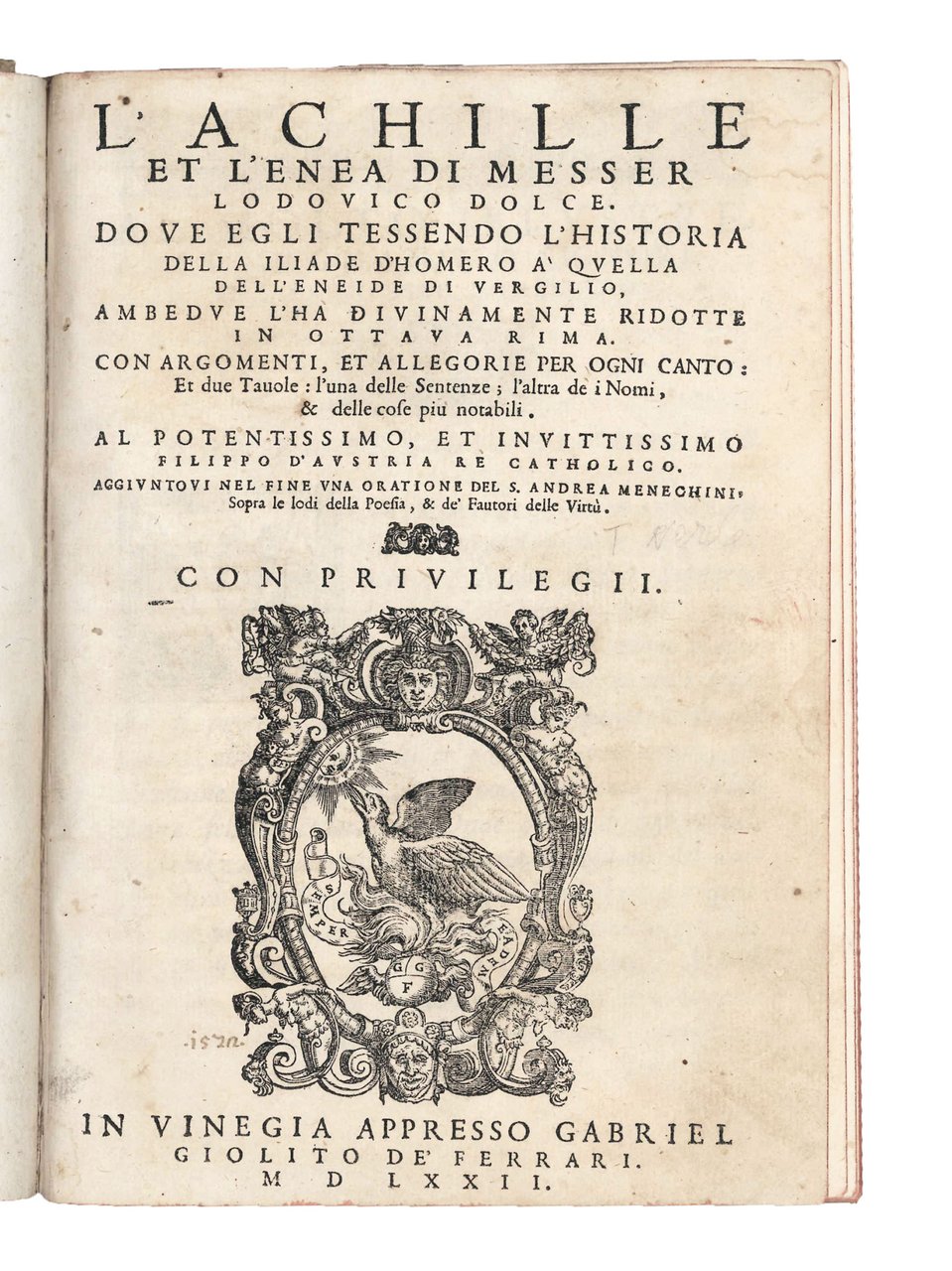
L'Achille et l'Enea di messer Lodovico Dolce. Dove egli tessendo l'historia della Iliade d'Homero a' quella dell'Eneide di Vergilio, ambedue l'ha divinamente ridotte in ottava rima. Con argomenti, et allegorie per ogni canto et due tavole: l'una delle sentenze; l'altra de i nomi, & delle cose piu notabili. Aggiuntovi nella fine una oratione del s. Andrea Menechini sopra le lodi della poesia, & de' fautori delle virtù.
L'Achille et l'Enea di messer Lodovico Dolce. Dove egli tessendo l'historia della Iliade d'Homero a' quella dell'Eneide di Vergilio, ambedue l'ha divinamente ridotte in ottava rima. Con argomenti, et allegorie per ogni canto et due tavole: l'una delle sentenze; l'altra de i nomi, & delle cose piu notabili. Aggiuntovi nella fine una oratione del s. Andrea Menechini sopra le lodi della poesia, & de' fautori delle virtù. | Libri antichi e moderni | DOLCE, Ludovico (1508–1568) - MENECHINI, Andrea (fl. 16th-ce
L'Achille et l'Enea di messer Lodovico Dolce. Dove egli tessendo l'historia della Iliade d'Homero a' quella dell'Eneide di Vergilio, ambedue l'ha divinamente ridotte in ottava rima. Con argomenti, et allegorie per ogni canto et due tavole: l'una delle sentenze; l'altra de i nomi, & delle cose piu notabili. Aggiuntovi nella fine una oratione del s. Andrea Menechini sopra le lodi della poesia, & de' fautori delle virtù.
L'Achille et l'Enea di messer Lodovico Dolce. Dove egli tessendo l'historia della Iliade d'Homero a' quella dell'Eneide di Vergilio, ambedue l'ha divinamente ridotte in ottava rima. Con argomenti, et allegorie per ogni canto et due tavole: l'una delle sentenze; l'altra de i nomi, & delle cose piu notabili. Aggiuntovi nella fine una oratione del s. Andrea Menechini sopra le lodi della poesia, & de' fautori delle virtù. | Libri antichi e moderni | DOLCE, Ludovico (1508–1568) - MENECHINI, Andrea (fl. 16th-ce
Metodi di Pagamento
- PayPal
- Carta di Credito
- Bonifico Bancario
- Pubblica amministrazione
- Carta del Docente
Dettagli
- Anno di pubblicazione
- 1572
- Luogo di stampa
- Venezia
- Autore
- DOLCE, Ludovico (1508–1568) - MENECHINI, Andrea (fl. 16th-ce
- Editori
- Gabriel Giolito de'' Ferrari
- Soggetto
- Quattro-Cinquecento
- Stato di conservazione
- Buono
- Lingue
- Italiano
- Legatura
- Rilegato
- Condizioni
- Usato
Descrizione
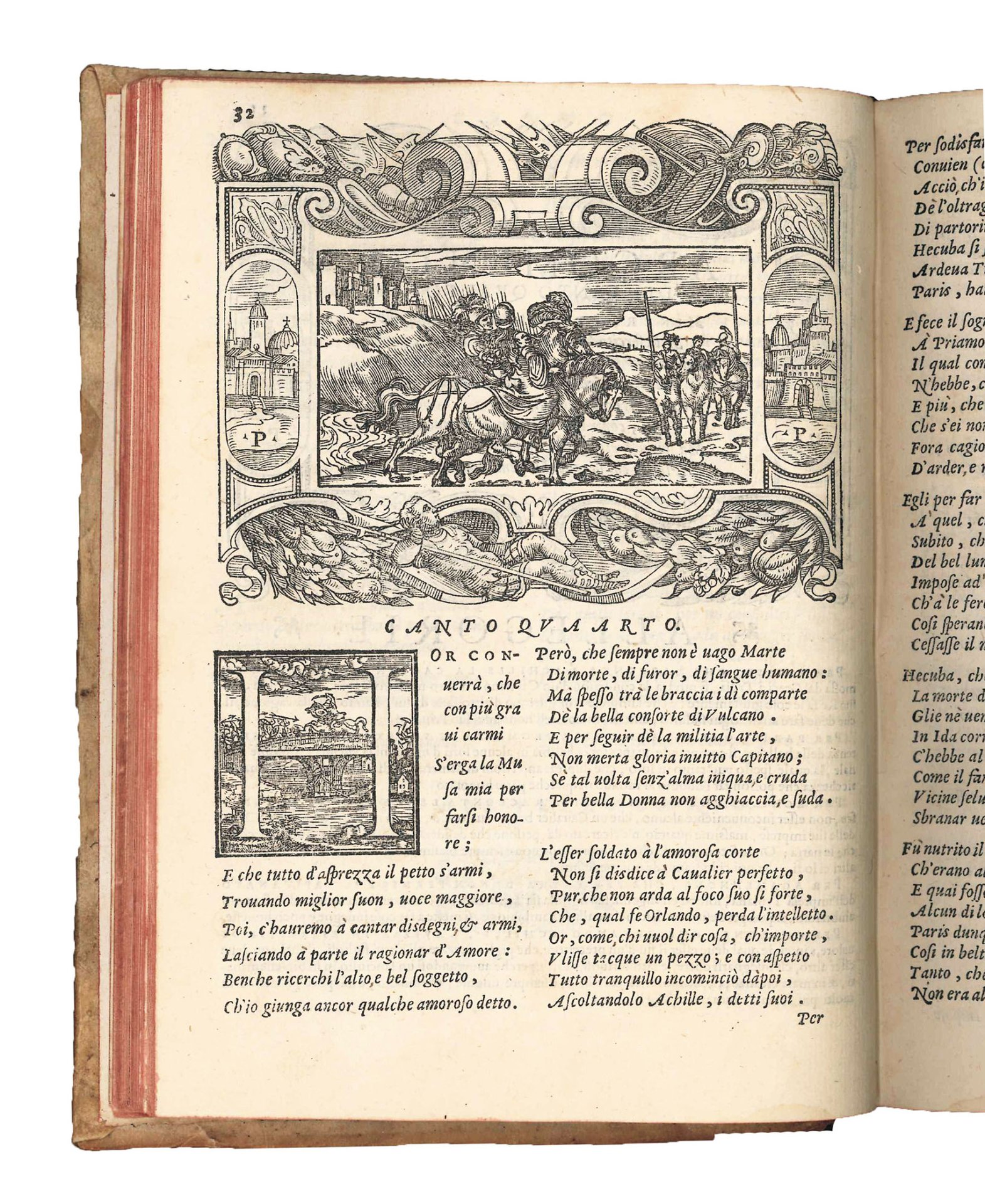
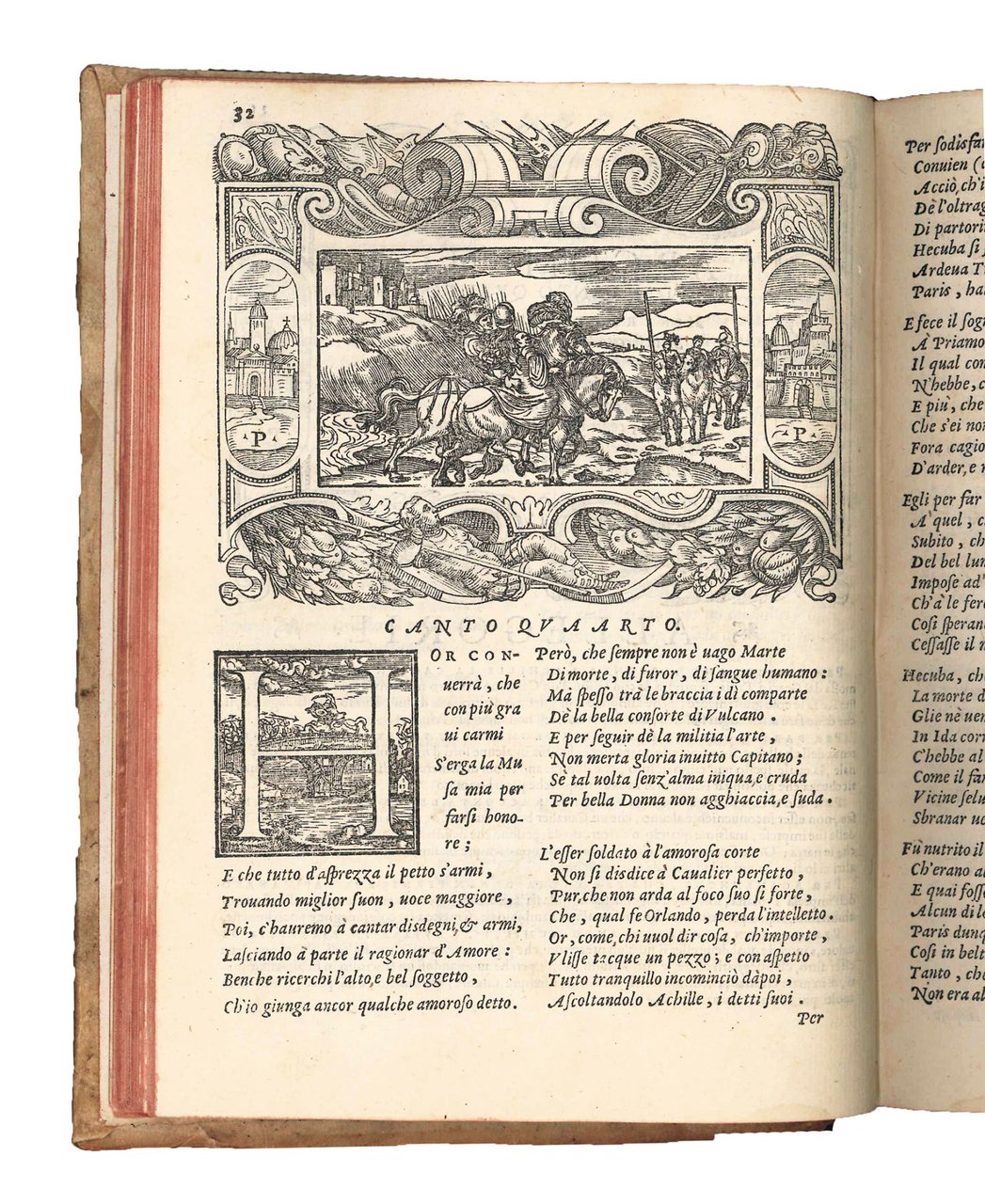
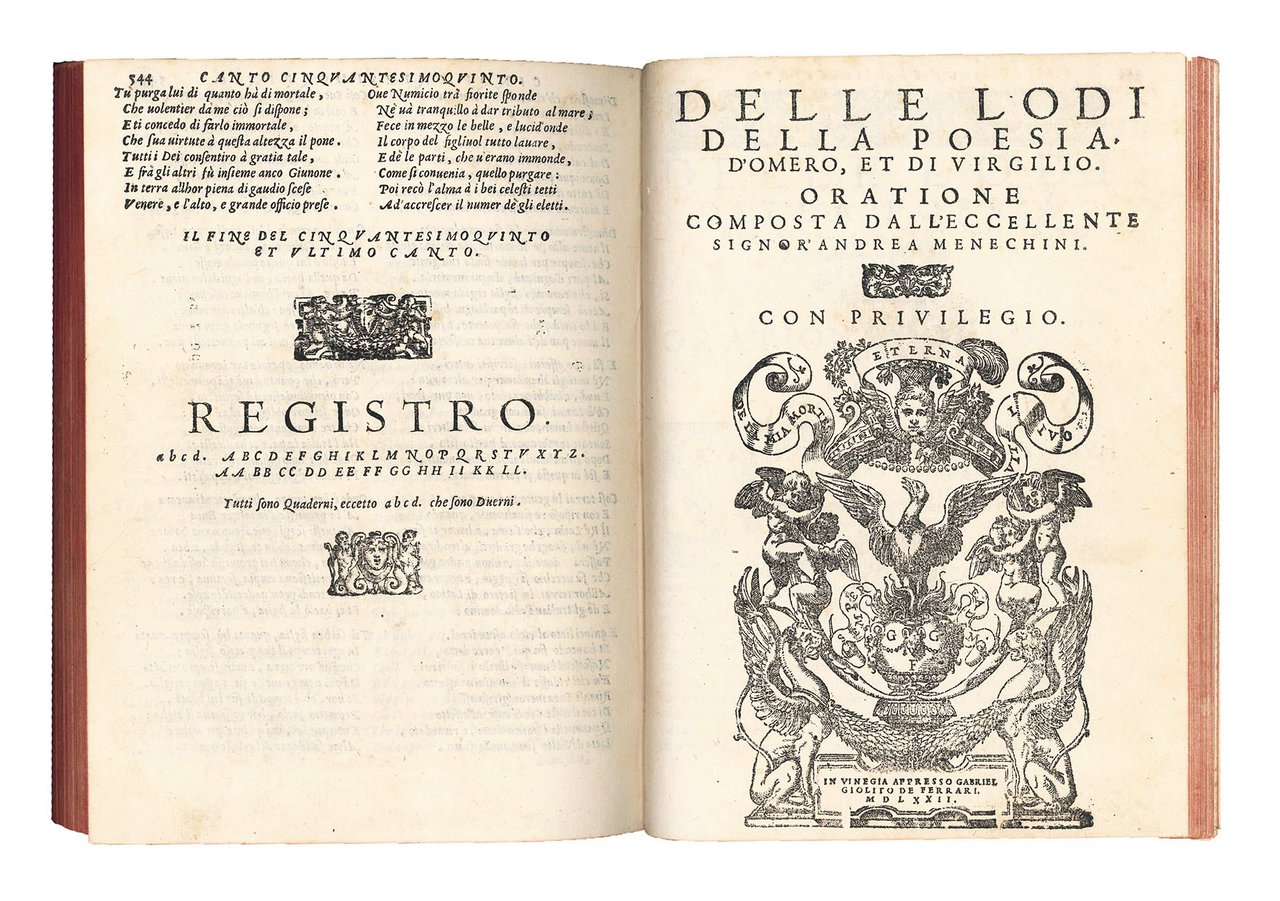
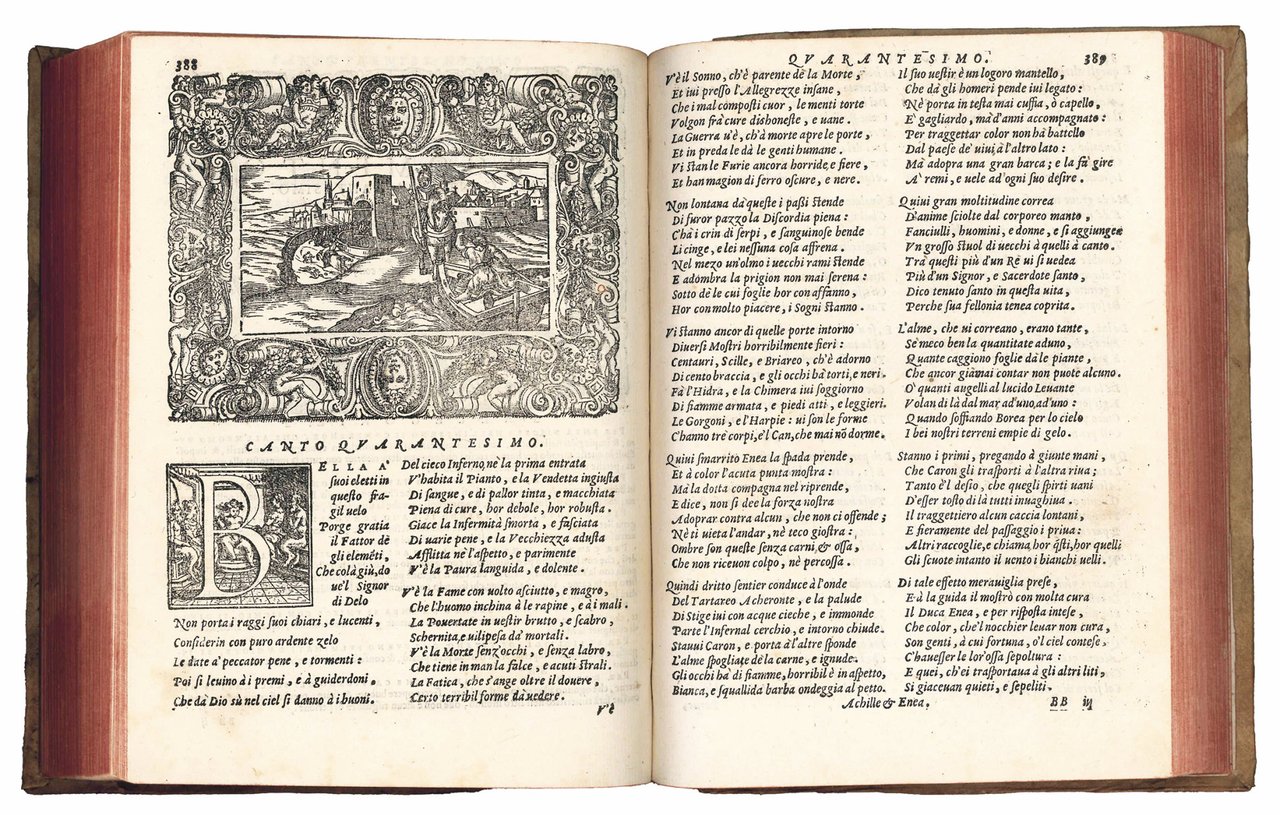
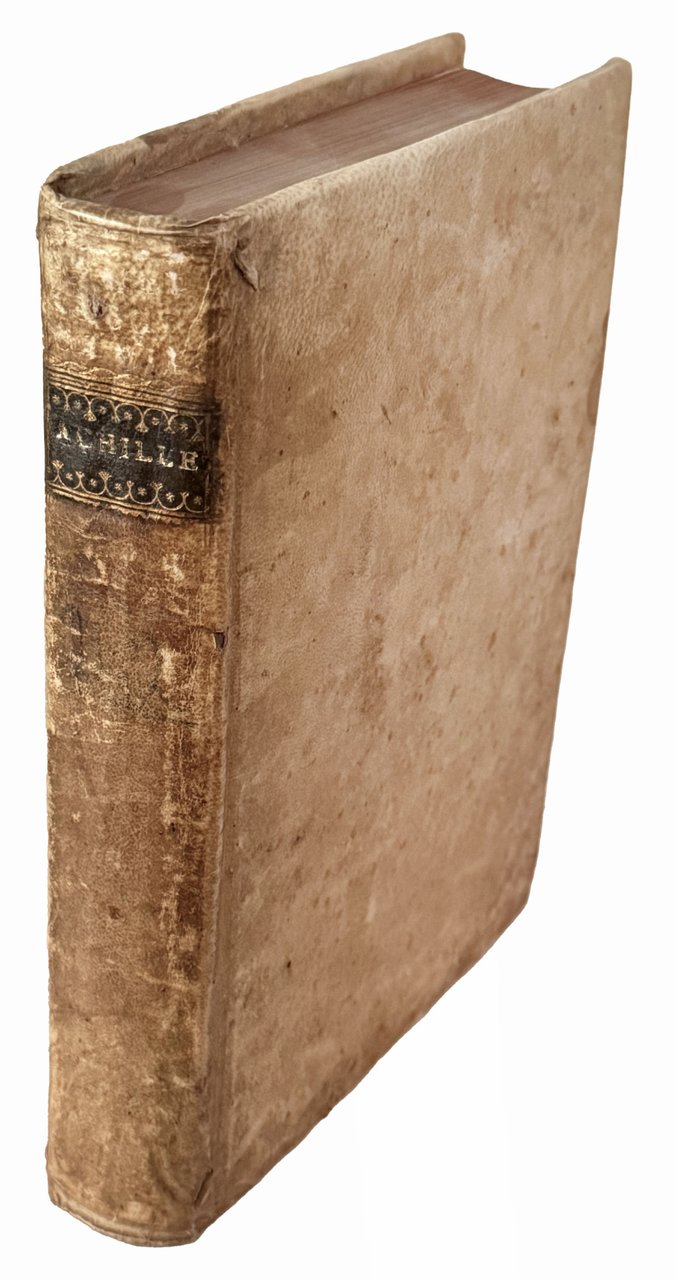
Two parts in one volume with separate titles and collation, 4to (210x155 mm). Collation: a⁶ a-b⁴ A-LL⁸; a-d⁴ e⁶. [28], 544; [44] pp. With woodcut Giolito's device on both title-pages. At l. a6v medallion woodcut portait of Dolce within a full-page architectural border with coat-of-arms. Woodcut head- and tail-pieces, large historiated initials. 55 half-page woodcuts (from 27 blocks) by Girolamo Porro (1520-1604), one at the beginning of each canto. The illustrations are from the set of blocks designed for the Ariosto of 1542, edited by Dolce and printed by Giolito. Here they are printed within borders from three different blocks, one with implements of war, city views, and a reclining warrior, and two with scrollwork, cherubs, and grotesques. The city views are labelled 'P.' The same borders are used to enclose a verse 'Argomento' at the beginning of each canto. Menechini's text is unillustrated. Text in octaves, printed in two columns in roman and italic type. Indexes in ruled columns, final registro at the l. LL8v. 18th-century stiff vellum with gilt title on lettering piece on spine, red edges (binding slightly worn and soiled). First leaves slightly and uniformely browned, small worm hole on the first title-page not affecting the text, otherwise a good and genuine copy.
Third edition (first 1570), typographically very elegant, of this poem in 55 cantos, one of Dolce's unpublished works that Giolito published posthumously based on manuscripts held in his printing house. The work combines elements from the classic Homeric and Virgilian epics, the Iliad and the Aeneid. The poems of Homer and Virgil are adapted into stanzas, and the text is accompanied by topics inspired by the Orlando Furioso, allowing an allegorical reading oriented towards moral and practical teaching. The work contains numerous illustrations depicting battle scenes, spells, animals, magic, monsters, knights and chivalric duels, celebrating the two famous poems of classical Greek and Roman literature.
Menichini's oration had already been printed at the end of Lodovico Dolce's Achille et Enea a year earlier. In his speech Menichini celebrates Dolce, who with his translation had made of Homer and Virgil Italian poets: “egli ha accomodato il poema all'uso ricevuto et aggradito della moderna poesia, onde il Dolce merita ogni lode di aver seguito la strada de' Moderni” (cf. M. Bianco, Il ‘Tempio' in onore: parabola di un genere antologico cinquecentesco, in: “Miscellanea di Studi in onore di Giovanni da Pozzo”, Rome, 2004, p. 177).
Only a smaller part of Menichini's speech deals with the poetry of the ancients, the main portion of it gives a comprehensive overview of the contemporary Italian poetry and poets, as well as their patrons. Among the numerous celebrated authors are Federico Badoer, founder of the Accademia della Fama, Giulio Camillo, Alberto Lollio, Luigi Alamanni, Girolamo Muzio, Francesco Patrizi, and many others, giving also sometimes short biographical details. The oration also contains examples of translations from ancient authors into Italian and furthermore sixteen sonnets by Menichini addressed to various Italian and foreign patrons (e.g. Queen Isabella of Naples, Charles, Ferdinand and John of Austria) (cf. L. Bolzoni, La stanza della memoria. Modelli letterari e iconografici dell'età della stampa, Turin, 1997, p. 222).
Ludovico Dolce, a native of Venice, belonged to a family of honorable tradition but decadent fortune. He received a good education, and early tried to maintain himself by the pen. He offers a good example of a new profession made possible by the invention of printing, that of the ‘polygraph' (poligrafo), in other words, a man of letters who made a living by working for a publisher, editing, translating and plagiarizing the works of others as well as producing some of his own. Thus Dolce for over thirty years worked as corrector and editor for the Giolito press. Translations from the Greek and Latin epics, satires, histories,